
Ayanna Thompson
Weyward Macbeth
So that we might learn what it means to remember one facet of our cultural legacy, we include in the book some two dozen concise essays addressing everything from Frederick Douglass’ allusions to the play, to hip-hop adaptations on YouTube, to Duke Ellington’s revisionary musical rendition, to multiracial prison productions.In addition to chapters we submitted as co-editors, over two dozen contributors include: Celia R. Daileader, Heather S. Nathans, John C. Briggs, Bernth Lindfors, Joyce Green MacDonald, Nick Moschovakis, Lisa N. Simmons, Marguerite Rippy, Lenwood Sloan, Harry J. Lennix, Alexander C. Y. Huang, Anita Maynard-Losh, José A. Esquea, William C. Carroll, Wallace McClain Cheatham, Douglas Lanier, Todd Landon Barnes, Francesca Royster, Courtney Lehmann, Amy Scott-Douglass, Charita Gainey-O’Toole, Elizabeth Alexander, Philip C. Kolin, Peter Erickson, Richard Burt, and Brent Butgereit.As the collection is designed to combat the historical amnesia about this play’s weyward history within dialogues about race, we also include an appendix of non-traditionally cast productions. Although it is impossible to catalogue every performance (even if one focuses primarily on professional productions in the United States), the 100 productions featured in this appendix reveal how often producers, directors, actors, and reviewers imagine themselves working in a vacuum.Documenting the frequency of these productions and analyzing the adaptations, appropriations, and allusions, Weyward Macbeth positions the “Scottish Play” in the center of American racial constructions. Shakespeareans alone could not tell this eclectic story: we needed Americanists, filmmakers, musicians, musicologists, actors, directors, and artists to tell a tale that signifies something about Macbeth, race, and the American imagination from as many viewpoints as possible.Macbeth’s insistent language of blood and staining seeps into American racial rhetoric. Macbeth focuses on the indelible quality of blood, that smelling substance that Lady Macbeth can’t fully wash from her hands.This unnervingly coincides with early American debates about the nature—the essence—of race. On the one hand (excuse the pun), the proponents of slavery (and later segregation) insist that the blood is the thing: the essential, internal substance that marks races, even down to a single drop. On the other hand, many opponents of slavery (and later segregation) quote passages about blood from Macbeth in their protest speeches: the external mark that stains America’s formation and history.We feel that the very weyward qualities—in all of their myriad complexities—of Shakespeare’s playtext, its performance history, and the critical scholarship must be brought into focus so that our desires for progressive acts are not disabled before they even begin. A conscious remembering, revisioning, and restaging is the true first step to change and progress.
Editor: Erind Pajo
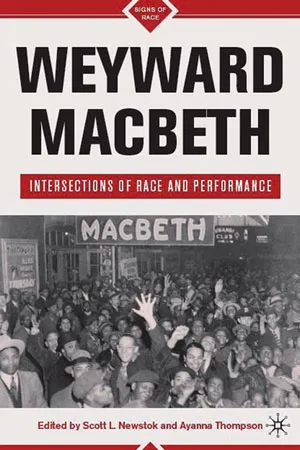
Weyward Macbeth
Scott Newstok and Ayanna Thompson, Editors Weyward Macbeth: Intersections of Race and Performance Palgrave Macmillan308 pages, 6 1/8 x 9 1/4 inches ISBN 978 0230616424
Available here →December 27, 2010
20101227-scott-newstok-ayanna-thompson-on-weyward-macbeth-race-performance-3
A close-up
The rest of this thread

Ayanna Thompson
Ayanna Thompson is Associate Professor of English, and an affiliate faculty in Women & Gender Studies and Film & Media Studies at Arizona State University. She is author of Performing Race and Torture on the Early Modern Stage (2008), and the editor of Colorblind Shakespeare: New Perspectives on Race and Performance (2006). Her new book on Shakespeare and race, called Passing Strange, is forthcoming from Oxford.
Pull this thread
Macbeth, not only Othello, sits at the center of American racial construction.
Know something the rest of us don't?
Most threads on Rorotoko begin with our invitation. Any thread can begin with a proposal: you write it with the same prompts every thread answers, and we review it.
Propose a thread →