
Ayanna Thompson
Weyward Macbeth
There are plans in the works for a multiracial film version of Macbeth. Like the famous 1936 production that Orson Welles directed in Harlem, this adaptation is to be set in the Caribbean. Yet neither the Hollywood movie nor the Welles stage production are the first Macbeths to find the play unusually well-suited to American racial discourse.
Macbeth was the first play documented in the American colonies, held by a plantation owner in 1699 Virginia. Many 19th century abolitionists, including Frederick Douglass, called upon Macbeth in their speeches. Artists ranging from Langston Hughes to Duke Ellington to Suzan Lori-Parks invoke it in their work. What exactly is it about Macbeth that’s so conducive to discussions about race in the United States?
Weyward Macbeth is a collection of two dozen essays that explore this topic. We co-edited the book based on a conference held at Rhodes College in 2008.
Why did we use that strange word “weyward” in our title? That’s the original spelling of the “weird sisters,” or witches, in the first edition of Shakespeare’s play, from 1623. And we think “weyward” aptly captures some of the peculiar dynamics of this drama.
On first glance, the intersections of race and performance in Macbeth might seem arbitrary.
Yet there remains something unique about Macbeth: it’s the haunted play, with the title you’re not supposed to name in a theatre. (Recall the minor hubbub when President Obama cited Lincoln’s fascination Macbeth at the February 11, 2009 re-opening of Ford’s Theater.)Macbeth is the drama in which “nothing is / But what is not.” Macbeth is anomalous and different—”Other,” to use the lingo of literature scholars. At its core, the “Scottish play” is about the distinctions between a king and one who wears “borrowed robes.” Should we be surprised that Macbeth is not the antithesis of a “race” play?
Editor: Erind Pajo
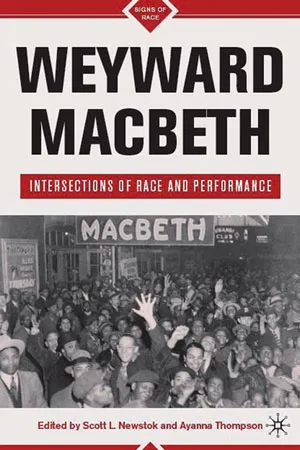
Weyward Macbeth
Scott Newstok and Ayanna Thompson, Editors Weyward Macbeth: Intersections of Race and Performance Palgrave Macmillan 308 pages, 6 1/8 x 9 1/4 inches ISBN 978 0230616424
Available here →December 27, 2010
20101227-scott-newstok-ayanna-thompson-on-weyward-macbeth-race-performance-1
In a nutshell
The rest of this thread

Ayanna Thompson
Ayanna Thompson is Associate Professor of English, and an affiliate faculty in Women & Gender Studies and Film & Media Studies at Arizona State University. She is author of Performing Race and Torture on the Early Modern Stage (2008), and the editor of Colorblind Shakespeare: New Perspectives on Race and Performance (2006). Her new book on Shakespeare and race, called Passing Strange, is forthcoming from Oxford.
Pull this thread
Macbeth, not only Othello, sits at the center of American racial construction.
Know something the rest of us don't?
Most threads on Rorotoko begin with our invitation. Any thread can begin with a proposal: you write it with the same prompts every thread answers, and we review it.
Propose a thread →