
Monica L. Smith
A Prehistory of Ordinary People
My interest in writing this book came from my most recent research on ancient urbanism. Cities are only about 6,000 years old, but our patterns of behavior and capacity for interaction with others started long before that. Indeed, our species’ ability to do many things at once, and to cope with interruptions in those workstreams, is evident in the archaeological record starting many thousands of years before the first cities, states, or empires.
A Prehistory of Ordinary People also reflects a broader shift of focus in archaeology. Traditionally, archaeologists have focused on the great and mighty, those who left impressive tombs and temples for us to uncover. Today the focus is more on the daily lives of the people who made those big constructions possible.
Archaeologists now investigate households, villages, and the surrounding landscape to see how the incremental actions of ordinary people changed the world over time. We can utilize the information that we get from even the most humble artifacts and architecture to look at how people deliberately made many choices about the world around them related to everyday activities such as growing food, making artifacts, and engaging with other people.
Those same processes of incremental action are still with us today. Our lives are a constant process of deciding and acting on what we will eat, wear, and work on next. Most of our daily activities, like those of our ancient ancestors, involve food, objects, and work. And like individuals in the past, we each embody our own health, memories, and identity through the use of the physical world around us. The cumulative effects of those individual decisions are evident not only in the notion of prevailing “styles” but also in the idea of shared culture through actions and language.
Our identities are made not only of the things that we do and wear in public, but also in the objects and thoughts that we articulate to ourselves. Much of our understanding of the world is self-contained and self-directed. Our memories are our own, and we remember events and actions slightly differently from others—even if they also were present. Our bodies are our own, and only we truly know our own state of health and wellbeing, about which we make selective comments to others. How often do we really answer the question “how are you?” with a detailed and accurate answer?
Humans also can simultaneously think in multiple time scales including the short-term, the medium-term, and the long-term. People stop and start activities while interleaving their time with other demands. Few tasks, whether making a meal or writing a project report, are done from start to finish without interruptions.
This stop-and-start approach to the world was true even for our long-ago hunting and gathering ancestors, who interwove their activities with many other tasks. Seasonal rounds of hunting and migration would be planned and adjusted on the basis of that day’s information about prey and shelter, with constant interruptions that might range from minor events such as an unexpected discovery of food to major events such as the birth of a baby or the death of a revered community elder.
Editor: Erind Pajo
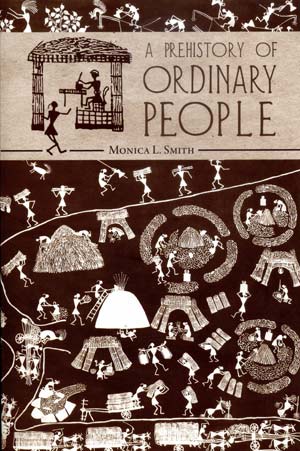
A Prehistory of Ordinary People
Monica L. Smith A Prehistory of Ordinary People University of Arizona Press 240 pages, 6 x 9 inches ISBN 978 0816526956
Available here →January 31, 2011
20110131-smith-monica-on-prehistory-ordinary-people-2
The wide angle
The rest of this thread

Monica L. Smith
Monica L. Smith is an anthropologist at the University of California, Los Angeles. She conducts research on urbanism and social dynamics through archaeological investigations, and has worked on digs and surveys in Turkey, Tunisia, Egypt, Italy, England, the United States, India, Bangladesh, and Madagascar. Besides A Prehistory of Ordinary People, featured in her Rorotoko interview, she is the editor of The Social Construction of Ancient Cities and author of a number of other books and research articles on ancient civilizations.
Pull this thread
pulls againstpulls alongside
Multitasking is a million-year-old species capacity, not a modern affliction, and monuments were built out of it from below.
Against JE · Lincoln's rise was contingent, and the sense of its inevitability is an artifact of how 1860 is taught. On: Historical meaning lies in exceptional events rather than in the texture of ordinary life
Against WS · Every cause of the Great Divergence is downstream of one condition, that no empire like Rome ever returned to Europe. On: Historical meaning lies in exceptional events rather than in the texture of ordinary life
Alongside EC · American houses were shaped by food, by dwellers rearranging space for storing, preserving, cooking and serving it. On: Historical meaning lies in exceptional events rather than in the texture of ordinary life
Alongside LB · Staying attached to what wears you out is the structure of optimism, not irrationality. On: Historical meaning lies in exceptional events rather than in the texture of ordinary life
Alongside AA · Photography constitutes a citizenry no sovereign can close, and watching is a duty the governed owe one another. On: Historical meaning lies in exceptional events rather than in the texture of ordinary life
Alongside KW · The Newcastle plague of 1636 killed almost half the population and did not dissolve its society. On: Historical meaning lies in exceptional events rather than in the texture of ordinary life
Nearby WH · The Greeks and Romans were more skeptical of their dreams than credulous.
Nearby SM · Hearing is something people do, and expert perception is collectively cultivated by teachable tricks.
Know something the rest of us don't?
Most threads on Rorotoko begin with our invitation. Any thread can begin with a proposal: you write it with the same prompts every thread answers, and we read it.
Propose a thread →