
A close-up
February 7, 2011
Enduring Success
A section in Chapter 3 on how companies learn over time and across space is titled “Learning Stories.” Naturally, corporations love to tell heroic stories. They help to motivate people and inspire others to follow their example. Which makes sense. But great companies are also prepared to learn from their own mishaps rather than sweeping them under the carpet.
In the Anglo-Dutch oil giant Shell, for example, a powerful story related to Henry Deterding, the company’s former CEO. Henry was a brilliant businessman who engineered the merger between the British Shell Transport and Trading and Royal Dutch in 1907. His success put him in a position of unchallenged power. Unfortunately, after the nationalization of Shell by communist Russia, he felt that only Adolf Hitler could stop the enemies of capitalism.
Fortunately, he retired before he could create any compromising links between Shell and Nazi Germany. It is interesting how Shell dealt with this near disaster in subsequent years. We would expect them to quickly forget about the embarrassment. They did not. On the contrary, they were determined to learn from it.When in 1964 McKinsey, an influential consulting company, recommended that Shell reorganizes and installs a strong CEO, the company remembered the story of Henry Deterding. They decided that, in a politically-sensitive industry like theirs, it would be better for a number of individuals to share responsibilities. So, instead, Shell installed a committee of managing directors.
The outside world never liked its structure but Shell had learnt from its past.Whenever the economy takes a dive in the manner we experienced after the subprime housing crisis, the public, media, and businesspeople seem to wonder why some corporate giants fail while others survive. This book provides some systematic insights from history. Rather than speculating about potential tips and tricks, the book builds upon careful analysis and recalls insightful stories from the past.
As I talked to managers across the world, and was questioned by journalists about my work, they were always particularly interested in knowing to what extent I thought my insights would help companies in the future. My answer has always been the same. We have a tendency to view our times as unparalleled and uniquely challenging. In fact, every generation does that. When Romans learned that Julius Caesar was assassinated in the Senate in 42 B.C. they surely thought the world would come to an end.
When, in 1966, Neil Armstrong raised the American flag on the moon, the exploration of space no longer seemed pure science fiction. And, when in 1989, the Berlin Wall tumbled down, millions of people cheered to a new world order. Yes, every generation faces a unique set of challenges. This, however, does not mean that we cannot learn from past experiences.
The companies studied in Enduring Success survived the Great Depression, two World Wars, and the Oil Crisis. They saw the advent of new technologies such as television, air travel, and the internet. Their history may not provide immediate solutions for specific business’ problems—but it does provide profound insights into how companies can approach the challenges they face and which strategies can help them prevail.
Editor: Erind Pajo
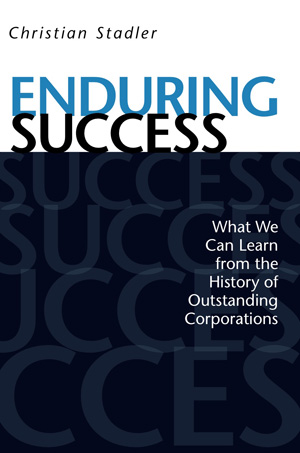
Enduring Success
Christian Stadler Enduring Success: What We Can Learn from the History of Outstanding Corporations Stanford University Press288 pages ISBN 978 0804772211
Get the book →February 7, 2011
20110207-stadler-christian-on-enduringuccess-what-learn-history-outstanding-3
The rest of this thread

Christian Stadler
Christian Stadler grew up in the Austrian Alps. He was first introduced to the fascination of history by his father, who taught the subject to 10 – 14 year olds. Christian started his academic career as an assistant professor at Innsbruck University, then moved to Tuck School of Business at Dartmouth, and currently teaches strategy at the University of Bath in the UK. His research in the past decade focused on long-living corporations””how they grow, adapt, and consistently beat their competitors. Christian is the author of Enduring Success: What We Can Learn from the History of Outstanding Corporations, featured in his Rorotoko interview (see also the book’s own site).
Feature your book, your art, your project
Publishing with a small press, or on your own?
A Sponsored Thread runs like every other thread on Rorotoko: three parts on three dates, the same editorial review, your own pages in the archive. Marked Sponsored. $199, paid only once accepted.
Get featured →