
Christian Stadler
Enduring Success
In Enduring Success I address a key question in business today: How can companies succeed over time?
I argue that companies are able to adapt to a constantly changing environment by being intelligently conservative. Which contrasts the widely held belief that great companies succeed because they are pioneering innovators that place bold bets on great ideas.
The argument unfolds in layers.
First, I describe what companies that succeeded for at least 100 years did differently from others. My main argument is that they made sure that their strategy and organizational setup fit the environment of their business. Second, I explain how these companies did this consistently over time. I develop five principles, stressing the importance of keeping reserves for difficult times, investing in several ideas and businesses rather than a single one, making the most of existing knowledge rather than permanently chasing new insights, developing mechanisms to learn from past mistakes, and being sensitive to the culture of a company when it needs to change.
Third, I elaborate on the characteristics of an intelligently conservative leader. I argue that, similar to a soccer coach, intelligently conservative leaders create winning teams by providing appropriate incentive structures, sufficient training, and occasionally substituting a player. They cannot score the goals themselves.
I am aware that the notion that you survive radical environmental changes by being intelligently conservative is counterintuitive. Therefore, I take great care in developing my argument. I provide a detailed description of the data I use and how I analyzed the information I gathered. All the chapters are carefully referenced, and I also devote one chapter to a comparison of my ideas with other work on long-term success.
Editor: Erind Pajo
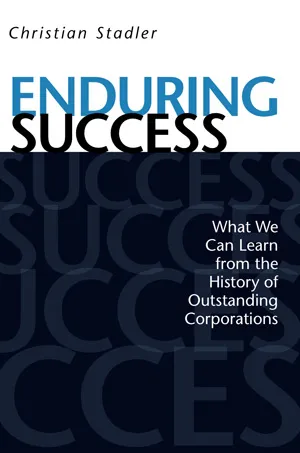
Enduring Success
Christian Stadler Enduring Success: What We Can Learn from the History of Outstanding Corporations Stanford University Press 288 pages ISBN 978 0804772211
Available here →February 7, 2011
20110207-stadler-christian-on-enduringuccess-what-learn-history-outstanding-1-1
In a nutshell
The rest of this thread

Christian Stadler
Christian Stadler grew up in the Austrian Alps. He was first introduced to the fascination of history by his father, who taught the subject to 10 – 14 year olds. Christian started his academic career as an assistant professor at Innsbruck University, then moved to Tuck School of Business at Dartmouth, and currently teaches strategy at the University of Bath in the UK. His research in the past decade focused on long-living corporations””how they grow, adapt, and consistently beat their competitors. Christian is the author of Enduring Success: What We Can Learn from the History of Outstanding Corporations, featured in his Rorotoko interview (see also the book’s own site).
Pull this thread
pulls againstpulls alongside
Companies that last a century beat the market by being intelligently conservative, not by bold bets on great ideas.
Against RP · Failure is not secretly good for us, and creative lives are made by continuation, not by talent destined to win. On: Failure, waiting and non-productive time are generative rather than simply wasted
Against TM · The welfare queen survives because stories demand antagonists, detail and resolution, and only better-told stories can dislodge her. On: A practice that persists over long periods does so because it works
Against MK · The free-market growth that caused climate change is also what will let households and firms adapt to it. On: Efficiency and optimization are the right design goals for systems that must survive shocks
Against KH · US vaccine innovation has been falling since World War II because development itself was broken into specialized, outsourced pieces. On: Failure, waiting and non-productive time are generative rather than simply wasted
Alongside JN · Bee signals evolved among spies and competitors, so a colony's stop signal matters as much as its waggle dance. On: Failure, waiting and non-productive time are generative rather than simply wasted
Alongside EB · Mutual-aid structure makes radical religious groups lethal, so governments should compete with them in providing benign services. On: A practice that persists over long periods does so because it works
Alongside JM · Metric fixation is predictably counterproductive, because what can be measured is not always what is worth measuring. On: Efficiency and optimization are the right design goals for systems that must survive shocks
Alongside KG · The mirror test never formed an intellectual tradition, and following the apparatus yields a different history of the mind sciences. On: Failure, waiting and non-productive time are generative rather than simply wasted
Know something the rest of us don't?
Most threads on Rorotoko begin with our invitation. Any thread can begin with a proposal: you write it with the same prompts every thread answers, and we review it.
Propose a thread →