
Susan S. Fainstein
The Just City
For more than 30 years, cities in America and Europe have moved toward greater inequality—in line with the ideology of neo-liberalism, which urges privatization, limits on social welfare, and low taxation.
Competition for resources—space, public office, economic goods, housing, group privileges, etc.—plays itself out within an ideological context emphasizing growth over social justice. And urban public policy has increasingly shifted from housekeeping and social service emphases to entrepreneurial efforts to foster growth.
In The Just City I use both deductive and inductive methods to argue for a normative framework that would change the criteria for evaluating urban policy. The book’s aim is to apply arguments about justice developed by contemporary philosophers to the concrete problems faced by urban planners and policy makers.
In the first part, I discuss the theories of John Rawls, Martha Nussbaum, Iris Marion Young, Nancy Fraser, and other philosophers who focus on the meaning of justice. I use these theories to develop an approach to justice relevant to 21st century cities in Europe and the United States, and to defend giving priority to justice in urban policy.
This discussion of justice is then examined in relation to the practical realities of urban planning and policy making—within cities’ national and global contexts, processes of social exclusion, governance issues, and conflicts within and variation among places.
From this discussion I then derive a set of broad principles by which to evaluate urban programs in the cities of the United States and Europe. The book’s second part examines three cities—New York, London, and Amsterdam—in relation to these principles.
In conclusion, I specify a program and urban policy recommendations that can further justice within the context of a capitalist city.
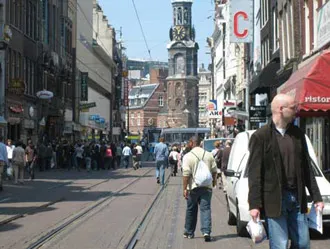
The example of Amsterdam shows that there is not necessarily a trade-off between investment and just outcomes. (Photo Susan Fainstein.)
Editor: Erind Pajo
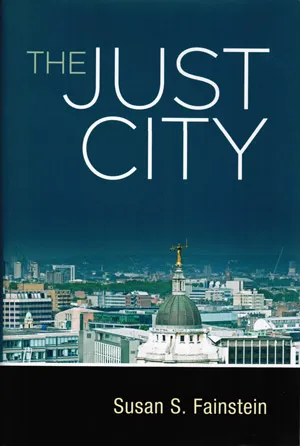
The Just City
Susan Fainstein The Just City Cornell University Press 232 pages, 9 1/4 x 6 inches ISBN 978 0801446559
Available here →February 16, 2011
20110216-fainstein-susan-on-the-just-city-1-1
In a nutshell
The rest of this thread

Norman Fainstein
Susan S. Fainstein
Susan S. Fainstein is a professor in the urban planning program at the Harvard University Graduate School of Design. She previously taught at Columbia and Rutgers. Besides The Just City, featured in her Rorotoko interview, she is the author of The City Builders and Restructuring the City, and co-editor of Cities and Visitors, The Tourist City, Gender and Planning, Readings in Planning Theory, and Readings in Urban Theory. Susan Fainstein is a recipient of the Distinguished Educator Award of the Association of Collegiate Schools of Planning (ACSP) for lifetime career achievement.
Pull this thread
Urban policy should be judged by equity, democracy and diversity, not competitiveness, and justice is not delivered by process.
Know something the rest of us don't?
Most threads on Rorotoko begin with our invitation. Any thread can begin with a proposal: you write it with the same prompts every thread answers, and we review it.
Propose a thread →