
Susan S. Fainstein
The Just City
Beginning in the 1960s, scholars of urban politics have criticized urban decision makers for imposing policies that exacerbated the disadvantages suffered by low-income, female, gay, and minority residents. In particular, they have condemned policies favoring downtown businesses while ignoring neighborhood needs and giving priority to tourist facilities and stadiums over schools and labor-intensive industries. These critiques have implied that a model of a just city exists against which actual cities can be evaluated.
Although there is a rich literature in planning and public policy prescribing appropriate decision-making processes, these process-oriented discussions rarely make explicit what policies would produce greater justice within the urban context. At the same time most policy analysis concerns itself with best practices or what “works” in relation to specific goals like producing more housing or jobs without interrogating the broader objectives of these policies.
Unlike social scientists, philosophers have long concerned themselves with the nature of justice. Since the publication of John Rawls’s Theory of Justice in 1971, philosophy has returned to the questions of values and governance that were central to it before the ascendancy of logical positivism.
The principal theories all posit an aspirational ideal according to which actual social policy can be formulated. The formulations, however, do not tell us what would be appropriate urban institutions and offer even less in terms of what actual programs would incorporate the criteria of justice that they propose.
The aim of The Just City is to develop an urban theory of justice and to use it to evaluate existing and potential institutions and programs.
Three principles of justice are derived from these philosophical works—equity, democracy, and diversity—and applied to urban public decision making. I limit the analysis to what appears feasible within the present context of capitalist urbanization in wealthy, formally democratic, Western countries.
My approach, after discussing the theoretical issues, is to consider urban development in the last thirty years in three metropolitan areas—New York, London, and Amsterdam. Building on these investigations, I then identify the strategies and policies that result in more just outcomes.
My earlier work proceeded along two paths: analyses and critiques of urban programs in the United States and Europe, and theoretical discussions of decision making processes, urban social movements, the relationship between social power and distributional outcomes, and the role of planners in improving urban life.
Both types of investigation centered on the question of justice and the extent to which it was an achievable goal. And I was inspired by a conference at Oxford, celebrating the twentieth anniversary of the publication of David Harvey’s Social Justice and the City, to begin to work toward developing a book that would bring together a formally stated theory of justice in the city with empirical investigation of the development policies of major cities.
I chose to compare New York, London, and Amsterdam because each typified a method of development along a continuum of less to more just, according to my criteria of diversity, democracy, and equity.
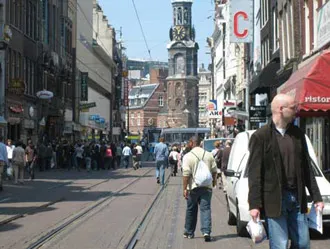
The example of Amsterdam shows that there is not necessarily a trade-off between investment and just outcomes. (Photo Susan Fainstein.)
Editor: Erind Pajo
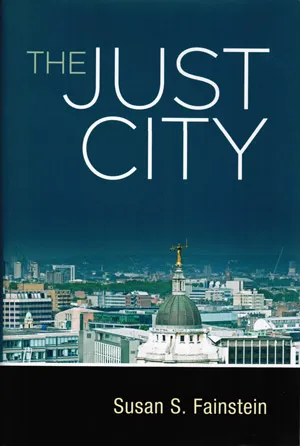
The Just City
Susan Fainstein The Just City Cornell University Press 232 pages, 9 1/4 x 6 inches ISBN 978 0801446559
Available here →February 16, 2011
20110216-fainstein-susan-on-the-just-city-2
The wide angle
The rest of this thread

Norman Fainstein
Susan S. Fainstein
Susan S. Fainstein is a professor in the urban planning program at the Harvard University Graduate School of Design. She previously taught at Columbia and Rutgers. Besides The Just City, featured in her Rorotoko interview, she is the author of The City Builders and Restructuring the City, and co-editor of Cities and Visitors, The Tourist City, Gender and Planning, Readings in Planning Theory, and Readings in Urban Theory. Susan Fainstein is a recipient of the Distinguished Educator Award of the Association of Collegiate Schools of Planning (ACSP) for lifetime career achievement.
Pull this thread
Cities should judge policy by equity, democracy and diversity, not by competitiveness.
Know something the rest of us don't?
Most threads on Rorotoko begin with our invitation. Any thread can begin with a proposal: you write it with the same prompts every thread answers, and we review it.
Propose a thread →