
Susan S. Fainstein
The Just City
The concluding chapter of the book briefly traces the broad historical forces that formed the context for present urban policies. It explains the effects of national policies on metropolitan areas and identifies the political and economic pressures that produced stronger redistributional measures during the 1960s and early 1970s, and then retrogression following the crisis of capitalism in the mid-1970s. I list specific local-level policies that, if followed, would create more just cities even in the absence of supportive national policies.
During the 1960s, protests over the quality of public programs and perceived discrimination in their execution occurred primarily within cities. Cities became the arena in which conflict among racial and ethnic groups took place, and they were the birthplace of movements for sexual freedom.
The uprisings of the period derived from group interests that often cut across class and that had their basis in group identity (blacks, gays) or ideology (feminists, environmentalists). Their success was in obtaining specific benefits, particularly in terms of hiring practices or access to funds for housing construction. But they lacked a base sufficiently broad for gaining strongly redistributive programs. Then, backlash against the reforms instituted in response to urban movements, within the context of fiscal crisis and global competition, led to policies that subsidized developers and cut back on benefits to low-income households.
I argue that urban planners and policy makers committed to justice can devise programs to counter this trend.
They lack the power to implement policy on their own, and they are restricted by their political masters and by their clients regarding the objectives they can seek. Nevertheless, urban planners and policy makers have one significant advantage that can empower them to shape policy. Much of planning and bureaucratic activity involves the collection and aggregation of data and the choice of how to present it. To the extent that individuals with expertise present analyses not just of benefit/cost ratios but also of who gets the benefits and who bears the costs, they can shift the debate toward a concern with equity.
To do so, however, they require support from some political base. In this respect citizen participation is important. Not because citizens always or even mostly place justice at the top of their hierarchy of values, but rather because citizens have an interest in knowing who is getting what.
Beyond sanctioned modes of participation the role of protest movements is crucial to more equitable policy. Without pressure from beneath, official participatory bodies are likely to become co-opted; when there is a threat from below, governments become more responsive to popular interests.
In conclusion, there are obvious limits on what can be accomplished at the metropolitan level. At the very least, however, a concern with justice can prevent urban regimes from displacing residents involuntarily, destroying communities, and directing resources at costly megaprojects that offer few general benefits.
More positively it can lead to policies that foster equitable distribution of governmental revenues, produce a lively, diverse and accessible public realm, and make local decision making more transparent and open to the viewpoints of currently excluded groups.
If the discourse surrounding policy making focuses on the justice of the decision rather than simply its contribution to competitiveness, much will have been accomplished. Discourse and outcomes are surely connected, but it is the substantive content of the discourse, not simply the process by which it is conducted, that matters if justice is to be the outcome.
Although the resources available to cities are determined largely by higher levels of government and the autonomous decisions of private investors, local public policy making still affects who gets what and is not fully constrained. The choices of objects for investment (e.g. stadiums v. housing, infrastructure v. incentives to private developers, schools v. convention centers) as well as locational decisions (e.g. where to put the bus station or public housing) are made by local governments.
Particular policy areas in which municipalities have considerable discretion and thus the power to distribute benefits and cause harm include urban redevelopment, housing programs, zoning, racial and ethnic relations, open space planning, and service delivery. Whether the policy emphasis and budgetary priorities should be on physical construction or human capital development, dispersion of low-income households or neighborhood improvements—these are decisions made locally.
My hope in writing a book about the just city is to influence readers to see more clearly who wins and who loses from policies framed in terms of competitiveness. Public officials, if they evaluated decisions in terms of the norms of diversity, democracy, and equity, would reach different conclusions than if they only focused on attracting more investment than other cities.
Although cities cannot flourish without investment, the welfare of their inhabitants depends on more than simply an assumption that the benefits of any investment will trickle down to everyone. The justice criterion does not necessarily negate efficiency and effectiveness as methods of choosing among alternatives. Rather, it requires the policy maker to ask: Efficiency or effectiveness to what end?
The measurement of outcomes in aggregate monetary terms leads to an apparent trade-off between efficiency and equity. If, instead of asking the overall benefit/cost ratio of a given project, we inquired as to the benefits and costs to those least well-off or those most directly and adversely affected, we would likely reach a different conclusion.
Making justice a priority would change the character of urban policy making.
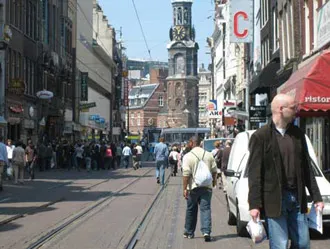
The example of Amsterdam shows that there is not necessarily a trade-off between investment and just outcomes. (Photo Susan Fainstein.)
Editor: Erind Pajo
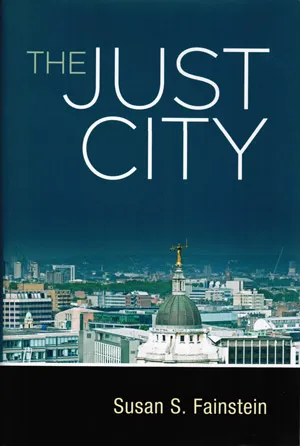
The Just City
Susan Fainstein The Just City Cornell University Press 232 pages, 9 1/4 x 6 inches ISBN 978 0801446559
Available here →February 16, 2011
20110216-fainstein-susan-on-the-just-city-3
A close-up
The rest of this thread

Norman Fainstein
Susan S. Fainstein
Susan S. Fainstein is a professor in the urban planning program at the Harvard University Graduate School of Design. She previously taught at Columbia and Rutgers. Besides The Just City, featured in her Rorotoko interview, she is the author of The City Builders and Restructuring the City, and co-editor of Cities and Visitors, The Tourist City, Gender and Planning, Readings in Planning Theory, and Readings in Urban Theory. Susan Fainstein is a recipient of the Distinguished Educator Award of the Association of Collegiate Schools of Planning (ACSP) for lifetime career achievement.
Pull this thread
Urban policy should be judged by equity, democracy and diversity, not competitiveness, and justice is not delivered by process.
Know something the rest of us don't?
Most threads on Rorotoko begin with our invitation. Any thread can begin with a proposal: you write it with the same prompts every thread answers, and we review it.
Propose a thread →