
Karen Beckman
Crash
Crash explores the role of the car crash in film history and contemporary art practice.
I begin by recognizing that the histories of cinema and the automobile, born at the same moment, are inextricably intertwined—but resist the assumption that the shared history of cars and films necessarily means that cinema is always resonant with concepts like speed, motion, flight, and progress.
You might think of this as an “anti-road movie” book. While in the Road Movie, as in mainstream action cinema, car crashes and other spectacles of technological disaster generally offer a moment of pause in which the narrative can either regain its momentum or take another direction, in the films I focus on, the moments of breakdown, technological failure, and the rupture of discreet bodies constitute the primary focus. I am interested in guiding attention towards these moments of narrative and visual stasis, and in examining how cinema presents itself when the camera is aligned not with the sweeping horizontal motion of a lone car moving through iconic American landscapes but rather with the modes of vision, relationality and experience that the car crash produces.
The book travels across the twentieth century, noting the persistence of this figure not only for filmmakers, but also for writers and artists trying to define their own practice through an engagement with this disaster-inflected view of what cinema is.
I begin by looking at a number of very short films made at the turn of the century by cinema’s earliest pioneers, including Cecil Hepworth and Walter R. Booth, all of which explore the new medium’s limits and possibilities through the parallel limits and possibilities of emerging automobile technology.
As I continue to pursue this relationship through silent slapstick comedies of Harold Lloyd and Laurel and Hardy, industrial safety films and car crash test films, it becomes clear that the cinematic car crash opens ways of thinking about not only what cinema is or could be, but also about how technology’s breakdowns create tears in the illusory fabric of social progress. These tears can function critically, allowing different ways of both looking at the world and using audiovisual technologies to reflect on those viewing habits.
The last four chapters of the book all explore this intertwining of social critique and aesthetic experimentation through close readings of works by Andy Warhol, Jean-Luc Godard, Ant Farm, J.G. Ballard, Alejandro González Iñárritu, and Nancy Davenport.
Editor: Erind Pajo
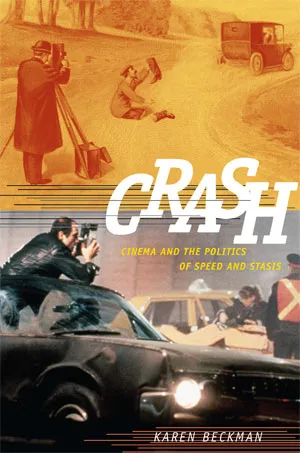
Crash
Karen Beckman Crash: Cinema and the Politics of Speed and Stasis Duke University Press 336 pages, 6 x 9 inches ISBN 978 0822347262 ISBN 978 0822347088
Available here →February 28, 2011
20110228-beckman-karen-on-crash-cinema-politics-speed-stasis-1-1
In a nutshell
The rest of this thread

Karen Beckman
Karen Beckman is the Elliot and Roslyn Jaffe Professor of Cinema and Modern Media in the department of the History of Art and the Program in Cinema Studies at the University of Pennsylvania. She is also a senior editor of Grey Room. Besides Crash, featured in her Rorotoko interview, Karen Beckman is the author of Vanishing Women: Magic, Film and Feminism (Duke, 2003) and co-editor of Still Moving: Between Cinema and Photography, (with Jean Ma, Duke, 2008), and Picture This! Writing with Photography (with Liliane Weissberg, Minnesota, forthcoming).
Pull this thread
pulls againstpulls alongside
Cinema and the automobile were born together, but the crash, not speed, is where film's critique becomes possible.
Know something the rest of us don't?
Most threads on Rorotoko begin with our invitation. Any thread can begin with a proposal: you write it with the same prompts every thread answers, and we review it.
Propose a thread →