
Minsoo Kang
Sublime Dreams of Living Machines
Sublime Dreams of Living Machines is about the millennia-long fascination in the West with the self-moving machine that mimics living beings, better known today by the word “robot.”
There are works that deal with specific issues of robotics or episodes in the history of automata. But this book presents a comprehensive history of the life-imitating machine as both a thing and an idea.
Readers may be surprised that my story does not begin with high-tech devices of the modern era but in the ancient world, when inventors like Hero of Alexandria already designed moving figures of humans, animals, and gods.
The narrative then moves to the Middle Ages when people told legends of a speaking head that could utter prophesies, to the age of Enlightenment. There was a veritable automaton craze in the eighteenth century. It was set off in the 1730s by the French mechanic Jacques de Vaucanson who displayed two automaton musicians as well as a duck that could flap its wings, move around, take food, and even defecate.
The last chapters take the reader to the modern era when the Industrial Revolution and the technological warfare of World War I aroused terrifying nightmares of machines rising up against humanity.
Sublime Dreams of Living Machines also deals with scientific and philosophical ideas that have been suggested by the automaton. Most importantly, I tackle the question of whether human beings can be described as machines. If so, what kind of a machine are we? If not, what makes us fundamentally different from a machine?
My larger purpose is to demonstrate that the automaton has been, and remains to this day, one of the central ideas in the Western imagination.
The automaton was utilized by some of the greatest thinkers, writers, and artists to ponder essential questions about the very nature of the universe, the state, and humanity. The philosopher René Descartes thought that a human being was an automaton built by God, with a nonmaterial soul residing in the brain—but he considered animals to be pure organic machines with no souls. Wolfgang von Kempelen’s so-called chess-playing automaton of 1770 beguiled both Europeans and Americans with its performances.
The book includes detailed analyses also of the view of modern machines as living creatures in the imagination of modernists—writers and artists like the surrealist Raymond Roussel, the futurist F. T. Marinetti, and the expressionist George Grosz.
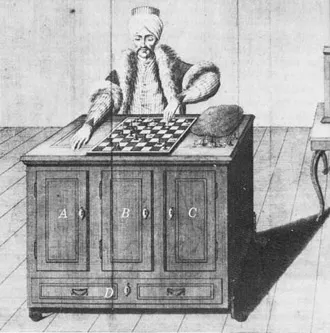
Wolfgang von Kempelen's Chess-Playing Turk, 1770
Editor: Erind Pajo
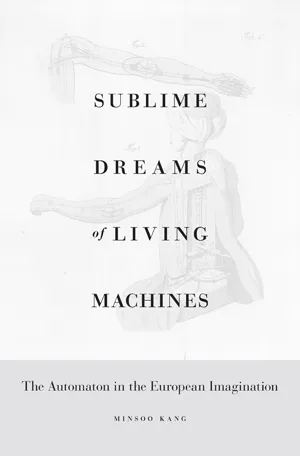
Sublime Dreams of Living Machines
Minsoo Kang Sublime Dreams of Living Machines: The Automaton in the European Imagination Harvard University Press 386 pages, 9¼ x 6¼ inches ISBN 978 0674049352
Available here →April 13, 2011
20110413-minsoo-kang-sublime-dreams-living-machines-automaton-europe-imagin-1-1
In a nutshell
The rest of this thread

Mia Ulmer
Minsoo Kang
Minsoo Kang is an associate professor of European history at the University of Missouri—St. Louis. In addition to Sublime Dreams of Living Machines, featured in his Rorotoko interview, and numerous articles on automata, experimental history, and European and Korean history, he has co-edited the book of essays, Visions of the Industrial Age, 1830-1914: Modernity and Anxiety of Representation in Europe. Minsoo Kang is also a fiction writer and author of a book of short stories, Of Tales and Enigmas. He is currently working on automata from the perspective of gender theory, a novel about automata, and on the classical Korean novel Hong Gildong Jeon.
Pull this thread
Automatons fascinate because a made thing that acts alive breaks the line between living and dead.
Know something the rest of us don't?
Most threads on Rorotoko begin with our invitation. Any thread can begin with a proposal: you write it with the same prompts every thread answers, and we review it.
Propose a thread →