
Stephen Schryer
Fantasies of the New Class
I hope that readers will begin with my introduction, which lays out the basic terms of my argument. However, casual readers might prefer to start with one of the chapters on the better-known novels that I work with: Ralph Ellison’s Invisible Man and Don DeLillo’s White Noise.My reading of Invisible Man juxtaposes the novel with Gunnar Myrdal’s 1944 sociological study of U.S. race relations, An American Dilemma. Ellison imagined his fiction as being at odds with the sociology of race. He wrote a review of An American Dilemma in which he argued that Myrdal oversimplified black culture by reducing it to a reaction to white racism. This review became one of the key texts that many black intellectuals drew on to express their distrust of damage sociology like Daniel P. Moynihan’s The Negro Family—a government study that argued that centuries of race discrimination had damaged the black family.I argue that the relationship between Ellison and Myrdal is much more complex than previous readers have imagined. Both writers embraced similar versions of new class cultural politics. Myrdal’s argument was that the American race problem arises from a conflict in the white psyche between an egalitarian American Creed embodied in founding documents like the Declaration of Independence and various local prejudices rooted in economic concerns. He believed that a project of national therapy was needed to resolve this conflict. The professionals were most suited to this; their education supposedly made them more attuned to the American Creed. Ellison, similarly, believed that racism was a series of cultural rituals founded on a conflict between ideals and prejudices, and he envisaged the novel as a force capable of healing the divided American psyche.However, Ellison also complicates this cultural politics in the only novel that he published in his lifetime, Invisible Man. In this book, Ellison tells the story of a young, would-be black professional who tries to find a path through various American institutions: a segregated college modeled after Tuskegee Institute in Alabama, the white-collar business world of New York, and a political organization modeled after the Communist Party U.S.A. In all of these institutions, the invisible man encounters a cynical opportunism at odds with the idealism that Ellison believed was embodied in the best American novels. This opportunism is rooted in the economic uncertainty of professionals, especially black professionals—the fact that they are dependent on outside patronage.For Ellison, in other words, what Myrdal refers to as the American Creed cannot be located in any specific class or institution, certainly not the new class of the 1940s and 1950s. In spite of his attraction to new class fantasy, in my book Ellison emerges as the figure who most clearly sees the economic underpinnings of American professionalism.I finished writing this book six months into the presidency of former law professor Barack Obama. For me, Obama represented a possible resurgence of the ideal of public-minded expertise—especially after the right-wing populism of George W. Bush. For the first time since Bush’s election, it seemed like a majority of Americans were growing to distrust the notion that gut instinct or patriotic feeling was enough to guide foreign and domestic policy decisions.The subsequent rise of the Tea Party movement highlights many Americans’ ongoing suspicion of the welfare state and of anything but the most narrow interpretation of professionals’ social function.In the face of this suspicion, my hope is that Fantasies of the New Class will help readers—especially readers in the academic humanities—get a clearer sense of the possibilities and limitations of cultural politics as traditionally practiced by literary intellectuals.For too long, writers and literary critics have cultivated an inflated view of themselves as offering an anti-instrumental antidote to the rationalism of U.S. society, a position that has often led them to embrace an anti-statist politics. My sense is that this is a dead end for liberal and left-wing politics. Social democracy in the United States—which impacts the ongoing survival of all first-world welfare states—instead depends on the existence of a pragmatic, socially-conscious professional class.
Editor: Erind Pajo
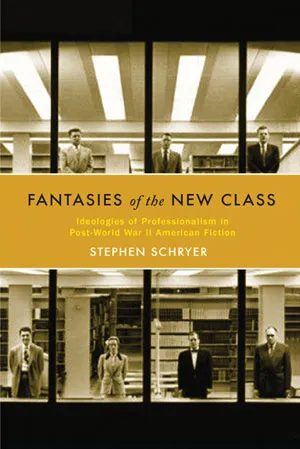
Fantasies of the New Class
Stephen Schryer Fantasies of the New Class: Ideologies of Professionalism in Post-World War II U. S. Fiction Columbia University Press 256 pages, 51/2 x 81/4ISBN: 978 0231157568ISBN: 978 0231157575
Available here →May 9, 2011
20110509-stephen-schryer-on-fantasies-new-class-ideologies-professionalism-3
A close-up
The rest of this thread

Stephen Schryer
Stephen Schryer is an assistant professor of English at the University of New Brunswick. He received his Ph.D. from the University of California, Irvine. In addition to Fantasies of the New Class, featured in his Rorotoko interview, Stephen Schryer has published in PMLA, Modern Fiction Studies, and Arizona Quarterly. He is working on a new book on post-World War II poverty discourse and American literature.
Pull this thread
Postwar writers who thought literary education could reform capitalism from within helped weaken the American welfare state.
Know something the rest of us don't?
Most threads on Rorotoko begin with our invitation. Any thread can begin with a proposal: you write it with the same prompts every thread answers, and we review it.
Propose a thread →