
Michael F. O’Riley
Cinema in an Age of Terror
I became interested in this topic because of previous research I had done on postcolonial theory. The book engages deeply with postcolonial theory and the interest in that discipline in bringing to light past injustices.
Much of postcolonial theory seeks to side with the position of the victim. Revealing the victim’s position is predicated upon the idea that the victim was rendered silent throughout much of colonial history and was unable to speak.
The era of decolonization enabled the colonized to speak, to represent their victimization at the hands of the colonizer. A good deal of that victimization took the form of terrorism and torture. A very empowering moment for the formerly colonized and their advocates was the advent of postcolonial theory; it enabled the representation of this once voiceless past to come into existence and, in a sense, to revise how history was viewed.
A good part of my career so far has been focused on the ways that postcolonial theory has been focused on images of the victim and the victimizer. An attempt to return those images to the present, to inscribe them and their moments of terror visually within the contemporary context seemed to me to be a central objective of postcolonial theory.
Although I undoubtedly deem this to be an important gesture, it also seems highly problematic. It raises the question of whether past oppositions and antagonisms are really ever transgressed, or whether they continue to be replayed.
If the dynamics of victimization from the past are replayed, what new types of relationships between the formerly colonized nation and the formerly imperialist nation can truly be forged? Would it be possible to break out of this cycle or would it simply engender a new generational opposition? Would this focus on victimization really enable a new type of history to emerge, in particular between the “West” and formerly colonized nations?
Much of the interest of postcolonial theory in determining what constitutes the West and its Other and, in particular, what divides them, seemed central to many of these questions for me. The putative “clash of civilizations,” opposing the “West” and its “Other,” that has been referred to widely in the wake of September 11 seemed to align with this geopolitical slant of postcolonial theory.
My interest in films focusing on the colonial era, where the “West” and the formerly colonized nation were underscored, seemed based on just such an opposition, a struggle that opposed the West and its Other, victim and victimizer, torturer and tortured. Such oppositions led me to consider how these images from colonial history might inform our understanding of terrorism and its structure of victimization.
Editor: Erind Pajo
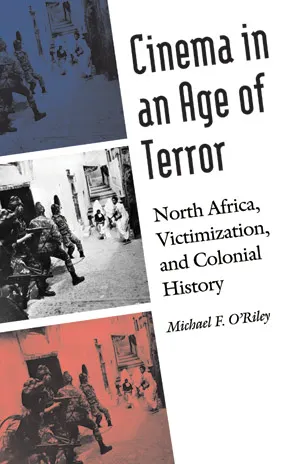
Cinema in an Age of Terror
Michael F. O’Riley Cinema in an Age of Terror: North Africa, Victimization, and Colonial History University of Nebraska Press 208 pages, 51/2 x 81/2 ISBN: 978 0803228092
Available here →May 16, 2011
20110516-oriley-michael-cinema-age-terror-africa-victimization-colonial-his-2
The wide angle
The rest of this thread

Michael F. O’Riley
Michael O’Riley is Associate Professor of French and Italian at The Colorado College. Besides Cinema in an Age of Terror, featured in his Rorotoko interview, he is the author of Francophone Culture and the Postcolonial Fascination with Ethnic Crimes and Colonial Aura and Postcolonial Haunting and Victimization: Assia Djebar’s New Novels. Michael O’Riley has been the recipient of a National Endowment for the Humanities grant for his work on cultural memory.
Pull this thread
pulls againstpulls alongside
Terrorism is a contest over who gets to occupy the position of the victim.
Against FG · Amateur films and photographs Germans made during the war are evidence in their own right, and exceed their makers' intentions. On: Images of distant suffering do ethical work for those who see them
Against RA · The hunger strike was pioneered by force-fed suffragists, though the men who used it later are the ones lionized. On: Images of distant suffering do ethical work for those who see them
Alongside CP · We owe wild animals in distress nothing, and special care to the animals we bred into dependence. On: Images of distant suffering do ethical work for those who see them
Alongside IG · US empire is waning, and the security state is the phase in which it turns to war to stay superpower. On: Images of distant suffering do ethical work for those who see them
Alongside CD · A victim is believed only insofar as he appears to have mastered his suffering. On: Images of distant suffering do ethical work for those who see them
Alongside WB · The distance Americans keep from deaths in Iraq is manufactured, and only putting the trigger in their hands breaks it. On: Images of distant suffering do ethical work for those who see them
Nearby NT · Soleil Ô was begun in 1965, shot mostly in 1969, screened in 1970, and made in France, not Mauritania.
Know something the rest of us don't?
Most threads on Rorotoko begin with our invitation. Any thread can begin with a proposal: you write it with the same prompts every thread answers, and we review it.
Propose a thread →