
Michael F. O’Riley
Cinema in an Age of Terror
I’d draw the attention of your “browser” to the book’s first chapter.The first chapter of Cinema in an Age of Terror discusses The Battle of Algiers, a film by the Italian Marxist director Gillo Pontecorvo. The film highlights the reciprocal victimization of the French and Algerians during the closing years of French colonialism in Algeria. It contains a rather graphic portrayal of terrorism as it is inflicted by both colonizer and colonized.In late summer of 2003, when resistance to the American occupation in Iraq acquired the profile of a war of guerilla insurgency through increased bombings and acts of sabotage, the office of Special Operations and Low-Intensity Conflict of the Pentagon prepared a special screening of Pontecorvo’s film for Pentagon officials involved in the war on terror.Although The Battle of Algiers clearly seems to side with the colonized Algerians in their struggle for independence, it definitely portrays how victimizer and victimized become locked in a cycle of victimization that becomes self perpetuating.So the first chapter of my book examines the dynamics of victimization and spectatorship that link colonial-era history to the history of terrorism in the present.In particular, I deal with the ways that the Pentagon screening of the film was directly related to occupying the position of the victim. In the wake of September 11th the U.S. identified clearly with the position of the terrorized victim.The Pentagon screening of Pontecorvo’s film was an attempt on the part of the U.S. government to understand better the position and tactics of what it perceived to be the victimizer—the Arab Muslim insurgent in this film’s case. However, such a perception also revealed how the U.S. was placing itself in the position of victim.The book not only discusses the fairly unknown use of a film on colonial history by the U.S. government, but it also demonstrates the importance of victimization within terrorism that my work attempts to underscore.Ideally, Cinema in an Age of Terror would enable some concerted reflection on the ways that reciprocal victimization structures terrorism.More importantly, it might enable an understanding of how terrorism might be seen as a contest over the ideological territory of the victim.Focusing, as it does, on such contests, the book demonstrates that victimization is central to the ways we see and create terror as well.The cultural and theoretical works I examine might demonstrate, in a larger sense, how our decision to adopt or renounce the victim’s position may be central to the perpetuation of a historical cycle of violence and opposition.
Editor: Erind Pajo
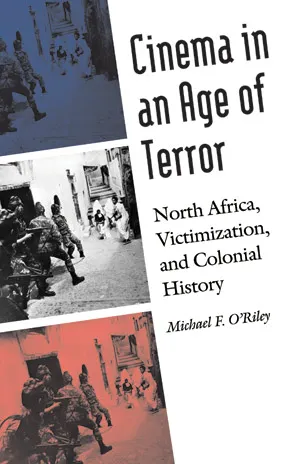
Cinema in an Age of Terror
Michael F. O’Riley Cinema in an Age of Terror: North Africa, Victimization, and Colonial History University of Nebraska Press 208 pages, 51/2 x 81/2 ISBN: 978 0803228092
Available here →May 16, 2011
20110516-oriley-michael-cinema-age-terror-africa-victimization-colonial-his-3
A close-up
The rest of this thread

Michael F. O’Riley
Michael O’Riley is Associate Professor of French and Italian at The Colorado College. Besides Cinema in an Age of Terror, featured in his Rorotoko interview, he is the author of Francophone Culture and the Postcolonial Fascination with Ethnic Crimes and Colonial Aura and Postcolonial Haunting and Victimization: Assia Djebar’s New Novels. Michael O’Riley has been the recipient of a National Endowment for the Humanities grant for his work on cultural memory.
Pull this thread
Terrorism is a contest over who gets to occupy the position of the victim.
Know something the rest of us don't?
Most threads on Rorotoko begin with our invitation. Any thread can begin with a proposal: you write it with the same prompts every thread answers, and we review it.
Propose a thread →