
Mary Beth Norton
Separated by their Sex
I may be perverse, but my favorite parts of the book are those that detail men’s most misogynistic or outrageous comments about women’s interest in public affairs.I think, for example, of the genre of English pamphlets on the theme of a parliament of ladies. (One such pamphlet supplies the book with its cover image.) Henry Neville, a political satirist of the 1640s, fantasized about an English House of Lords composed of aristocratic women in two brilliant, subtly pornographic pamphlets filled with clever double entendres. While reading them, I was repeatedly forced to stifle my laughter to avoid disturbing other patrons of the quiet rare-book reading room of the British Library (see pp. 53-60).Or there was Joseph Addison, warning women in 1711 that too much engagement with “party rage” would inevitably destroy their complexions and lead them to neglect their family responsibilities.And finally, the argument I see as the icing on the cake: the anonymous author who in the 1730s insisted that Queen Elizabeth was a hermaphrodite, because it was obvious that no true woman could have been a ruler as successful as she!I also think readers will enjoy the accounts of women’s tea-table socializing. The contrast between male writers’ critiques of women’s empty-headed gossiping and women’s own comments about the pleasures of exchanging ideas and, yes, gossip, with their friends, is striking and revealing.Plus, I had to learn the history of tea, one of my favorite beverages—I gave up coffee long ago. Who knew that Catherine of Braganza, the Portuguese wife of Charles II, first brought tea to England on her marriage in 1662? I didn’t—until I wrote this book.I hope this book will help scholars and other readers to stop automatically applying the modern concept of the public-private divide to societies that existed before approximately 1720.I now cringe whenever I read something that purports to describe the “private” realm in medieval Europe, for example. We shouldn’t employ such terms when writing about historical eras before the gendered notion of the private existed. If we do use them, we should acknowledge, at the very least, that they are inventions of the eighteenth century, and that we are applying them anachronistically.The knowledge of the invention of the public-private divide is crucial today—for modern Americans to understand that notions of “women’s proper sphere” were historically constructed.Ideas created nearly three hundred years ago can be changed when the circumstances that fostered them no longer apply. And then, perhaps, the next woman to run for president will not encounter the same assumptions and prejudices that confronted Hillary Rodham Clinton in 2008.
Editor: Erind Pajo
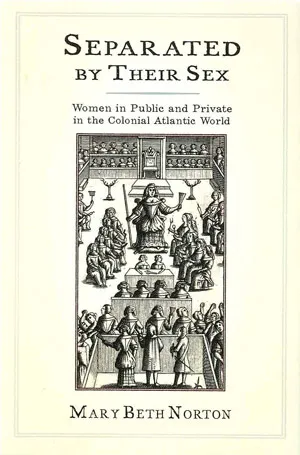
Separated by their Sex
Mary Beth Norton Separated by their Sex: Women in Public and Private in the Colonial Atlantic World Cornell University Press272 pages, 6 x 9 inches ISBN 978 0801449499
Available here →June 15, 2011
20110615-norton-mary-separate-sex-women-public-private-colonial-atlantic-3
A close-up
The rest of this thread

Robert Barker, Cornell University
Mary Beth Norton
Mary Beth Norton is the Mary Donlon Alger Professor of American History at Cornell University. Her previous books have won prizes from the Society of American Historians, the Berkshire Conference of Women Historians, and the English-Speaking Union. Her Founding Mothers & Fathers was a finalist for the Pulitzer Prize in 1997. Mary Beth Norton has held fellowships from the Rockefeller and Guggenheim Foundations, Princeton University, the Huntington Library, and was Pitt Professor of American History at the University of Cambridge in 2005-6. She is an elected member of the American Academy of Arts and Sciences and of the American Philosophical Society.
Pull this thread
The gendered public-private divide was invented in early eighteenth-century England by Dunton, Addison and Steele.
Know something the rest of us don't?
Most threads on Rorotoko begin with our invitation. Any thread can begin with a proposal: you write it with the same prompts every thread answers, and we review it.
Propose a thread →