
Harry Collins
Gravity’s Ghost
How do physicists decide that some data might constitute a discovery?
The way to find out is to watch. For 18 months I watched physicists arguing about a burst of data that turned up around the Fall Equinox of 1997 and became known as the “Equinox Event.”
What they saw was a little jump in the output that happened at the same time on both of the giant interferometers that make up LIGO –the Laser Interferometer Gravitational-Wave Observatory. Each of these interferometers has two arms at right angles that are two-and-half miles long. They are sighted around 2,000 miles apart, one in Washington State and one in Louisiana. So if they both go off together it suggests that something coming from a long way away was the cause.
But that’s only the start. Maybe the bursts were just coincidental noises on both devices. Maybe there was an earthquake or an electrical storm 1,000 miles from each. Maybe everyone got up and switched on the coffee-maker at exactly the same time when the ads came up during an exciting television program, causing a sudden glitch in the power grid.
It took 18 months for the physicists to argue out what they should say about the effect and during all this time they also knew the signal might be a fake put in deliberately to test them.
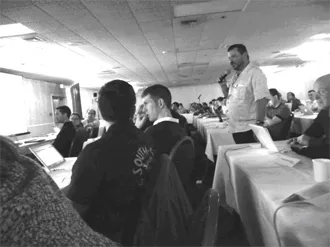
The decision (Photo: Harry Collins)
Editor: Erind Pajo
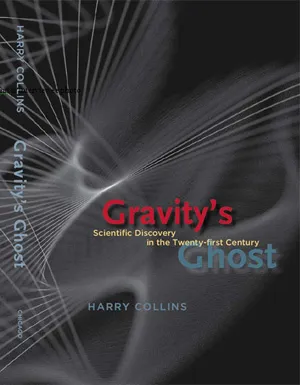
Gravity’s Ghost
Harry Collins Gravity’s Ghost: Scientific Discovery in the Twenty-first Century University of Chicago Press 200 pages, 6 x 9 inches ISBN 978 0226113562
Available here →June 22, 2011
20110622-collins-harry-gravity-ghost-scientific-discovery-in-the-twenty-first-century-1-1
In a nutshell
The rest of this thread
Cardiff University
Harry Collins
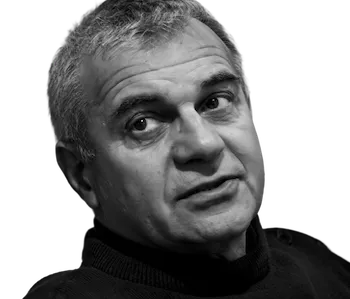
Harry Collins is Distinguished Research Professor of Sociology and Director of the Centre for the Study of Knowledge, Expertise and Science at Cardiff University. He has held visiting appointments in Brazil, China, United States, Germany, etc. He was awarded the 1997 Bernal prize for social studies of science and has also received the American Sociological Association’s Robert K. Merton book prize and the British Computer Society Specialist Group in Expert Systems Prize for Technical Merit. He has published sixteen books and around 150 papers. Harry Collins is continuing to research and write on gravitational wave detection, and, with support from a European Research Council Advanced Grant, on the nature of expertise and on a new technique for exploring expertise—the “Imitation Game.”
Pull this thread
A discovery in big physics is settled by long collective argument, not by insight.
Know something the rest of us don't?
Most threads on Rorotoko begin with our invitation. Any thread can begin with a proposal: you write it with the same prompts every thread answers, and we review it.
Propose a thread →