
Harry Collins
Gravity’s Ghost
There are two quite different aspects of the work to which I would want to draw a reader’s attention. The first aspect is what most of the book is about; the second aspect is the role of science in the Twenty-First Century, which is discussed in the ten page Envoi toward the end.
To get the idea of the body of the book I would hope the reader would open it at page 1 and read through to the end of the first paragraph on page 2. They would find out they were going to read a scientific detective story. Here were hundreds of scientists trying to work out what to say about a possible signal. Not only did they have to work this out, but lingering in the back of their minds was the possibility that the whole thing was a fake.
So there are really two detective stories intermingled, and one of the tensions in the book is how one affected the other. Did the possibility that the signals had been deliberately injected to test the community cause them to be less assiduous in the search or not? Mostly the scientists managed to suspend their disbelief. Given this they argued fiercely about what the signal should be said to mean. Some people were badly hurt, some people got very angry. Even at the end of the 18-month process no one was sure whether what they had done was a success or a failure.
Still more puzzles about how to handle data in a case like this were generated. Even I was surprised at extent of conflicting and contradictory views that came out at the post-mortem. I believe this is an exciting story—I certainly found it fascinating and was gripped throughout the 18 months, wondering about what was going to happen. I found myself getting involved in the arguments and disagreeing with my best friends in the project. Emotions were sometimes strained. All this comes out as the story unfolds.
Though the book is written in ordinary language I think the reader will also learn a lot about the almost unbelievable science of gravitational wave detection. The big detectors have arms 2.5 miles long and seeing a gravitational wave amounts to monitoring changes in the lengths of those arms as the wave passes. The scientists look at the length of one arm as compared to the other. The change in length they need to see is around 1,000th of the diameter of a proton—in an arm two-and-half miles long!
To get the other aspect of the book I would hope the reader would flick open page 154. This is where the meat of those final ten pages begins.
I ask what science is today. I worry that it is becoming a branch of the entertainment industry or an outlet for venture capital.
But science is much more important than that because of the values it cleaves to. These values have seeped out into society and inform the way we think about political decisions, not just technical decisions.
My field, the social studies of science, is politically savvy and somewhat cynical. We have done a marvelous job of showing the ordinariness of science, and we are experts at spotting the way political and economic interests affect what counts as scientific truth. But we have done these jobs so well that we in danger of losing sight of the positive elements of an ideal science.
Indeed, the reason that social scientists are so angry with science is that it does not live up to its own ideals. It is the importance of these ideals to which I draw attention in the Envoi.
The attack on them comes from a variety of directions, some of them less than obvious. For example, that millions of people revere Steven Hawking’s popular books is worrying; those millions surely do not understand them, so the works of science are being treated as something holy in themselves. Science, as it displaces religion, is taking up the very same iconography!
There are several different ways in which I would like the book to have influence.
I would like to create a new kind of science writing—to capture the excitement of science but without making up science fairy-tales. Science is nearly always a messy and untidy business, not a matter of sudden heroic insight. But this messy and untidy business is still exciting—it is fascinating to watch opinion forming through the interplay of argument and calculation.
Related to this point, I would like the book to lead to a better relationship between natural science and social science.
My own relations with the scientists who I have followed and interacted with for 45 years are very good. Indeed, I have just been asked to give an after-dinner address to a major international meeting of the group. But it would be nice if there were more relationships of this kind.
It is not only scientists’ suspicions that will have to cool, however. Social scientists will have to become more genuinely interested in the science they study. For me it is easy because I have always been fascinated by this field of physics.
Another kind of influence I would wish for the book is related to the others but it is more a matter of the general public. I would like the public to understand both the difficulty and uncertainty of reaching scientific conclusions—but also the enormous skill and virtuosity that goes into them.
The trick is to understand that the best possible conclusion may not turn out to be the right conclusion in the very long term. Only a seer can know the long term before it unfolds. But science is still a much better way to try to work out what is true than anything else we have.
The final influence I would like for the book relates to the Envoi. I would like it to become widely understand by both scientists and ordinary people that science contains a wonderful set of values at its heart. If scientists do not understand this, then science could become just another arm of capitalism, politics, or the entertainment industry. If ordinary people do not understand this, we might find ourselves back in a cultural condition we thought we have long escaped.
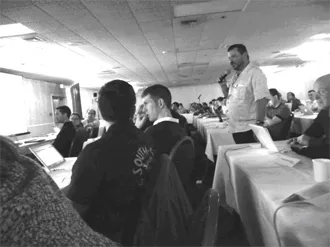
The decision (Photo: Harry Collins)
Editor: Erind Pajo
Gravity’s Ghost
Harry Collins Gravity’s Ghost: Scientific Discovery in the Twenty-first Century University of Chicago Press 200 pages, 6 x 9 inches ISBN 978 0226113562
Available here →June 22, 2011
20110622-collins-harry-gravity-ghost-scientific-discovery-in-the-twenty-first-century-3
A close-up
The rest of this thread

Cardiff University
Harry Collins
Harry Collins is Distinguished Research Professor of Sociology and Director of the Centre for the Study of Knowledge, Expertise and Science at Cardiff University. He has held visiting appointments in Brazil, China, United States, Germany, etc. He was awarded the 1997 Bernal prize for social studies of science and has also received the American Sociological Association’s Robert K. Merton book prize and the British Computer Society Specialist Group in Expert Systems Prize for Technical Merit. He has published sixteen books and around 150 papers. Harry Collins is continuing to research and write on gravitational wave detection, and, with support from a European Research Council Advanced Grant, on the nature of expertise and on a new technique for exploring expertise—the “Imitation Game.”
Pull this thread
A discovery claim in big physics is settled by eighteen months of fractious collective argument, not by insight.
Know something the rest of us don't?
Most threads on Rorotoko begin with our invitation. Any thread can begin with a proposal: you write it with the same prompts every thread answers, and we review it.
Propose a thread →