
Niobe Way
Boys' Friendships and the Crisis of Connection
Why have we, as a culture, ignored the intimacy in boys’ friendships for so long, despite the fact that research has revealed such intimacy among boys over the past century?
And why do boys lose their friendships as they grow older?
The reason appears to be that patterns and expressions of intimacy among boys are considered by our culture as girlish and gay. In other words, to admit that boys have or want emotionally intimate male friendships, or to reveal their emotional sensitivity, is to implicitly accuse them of being gay.
Rather than questioning why emotional sensitivity and emotionally intimate friendships are given, in our culture, sex (female) and sexuality (gay) connotations, we simply ignore boys’ friendships and the ways in which they do not fit our gender stereotypes.
And that appears to be the reason why boys lose their close friendships during late adolescence: cultural pressures to becoming men are intensified during this period of growth.
In American culture, becoming a man is linked with being emotionally stoic, autonomous, and physically tough. If boys do not follow these dictates of manhood, they are perceived as gay or girlish. Boys, particularly those who are heterosexual, don’t want to be perceived in such ways.
These changes also occur because boys, like girls, increasingly buy into the cultural belief that having a romantic partner makes you mature and happy and that romantic relationships are more important than friendships. They begin to believe, like many adults, that friendships should be sacrificed for the sake of romantic relationships.
Yet this belief system is relatively new. In the 19th century United States, couples took their best friends on their honeymoons. We now live in a culture where that would never happen. Today friendships are considered competition in a romantic partnership—not what may foster intimacy and the health and wellbeing of those involved in the friendships.
Editor: Erind Pajo
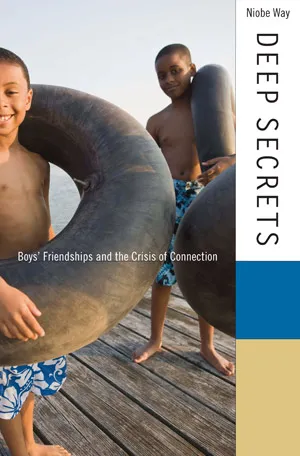
Boys' Friendships and the Crisis of Connection
Niobe Way Deep Secrets: Boys' Friendships and the Crisis of Connection Harvard University Press 326 pages, 5 1/2 x 8 1/4 inches ISBN 978 0674046641
Available here →June 29, 2011
20110629-way-niobe-deep-secrets-boys-friendships-crisis-connection-2
The wide angle
The rest of this thread

Niobe Way
Niobe Way is Professor of Applied Psychology at New York University, Director of the NYU Developmental Psychology Program, and Co-Director of the NYU Center for Research on Culture, Development, and Education. She is also the President for the Society for Research on Adolescence. Niobe Way received her doctorate from Harvard and was a postdoctoral fellow at Yale. Her research has been funded by the National Institute of Mental Health, The National Science Foundation, The William T. Grant Foundation, The Spencer Foundation, and other foundations. Besides Deep Secrets, featured in her Rorotoko interview, Way is the author of numerous books, including Everyday Courage: The Lives and Stories of Urban Teenagers.
Pull this thread
Boys lose their intimate friendships in late adolescence to culture, not to growing up.
Know something the rest of us don't?
Most threads on Rorotoko begin with our invitation. Any thread can begin with a proposal: you write it with the same prompts every thread answers, and we review it.
Propose a thread →