
Niobe Way
Boys' Friendships and the Crisis of Connection
My longitudinal research with hundreds of boys over the past twenty years has indicated that boys’ friendships, particularly during early and middle adolescence, are deeply intimate. They sound more like out of Love Story than Lord of the Flies.
White, Black, Latino, Chinese-American, and Chinese boys openly express their love for their friends. In in-depth interviews that I am my research team conducted, boys emphasized that sharing “deep” secrets was the most important aspect of their closest male friendships. They also told us that they would go “wacko” without these friends.
During late adolescence, however, boys begin to lose their closest male friendships, become more distrustful of their male peers, and in some cases, become less willing to be emotionally expressive. They start sounding, in other words, like gender stereotypes.
When late adolescent boys talk about the intimacy that might remain in their closest male friendships, they use the expression “no homo” to underscore their heterosexual status. Questions about close friendships from the interviewers become, for the boys during late adolescence, questions about sexuality.
For example, when Augustus (the fictional name for one boy quoted in the book) is asked in his freshman year of high school whether he has close male friendships, he describes the emotionally intimate friendships he has with a particular boy in his school. When he is asked about his closest friendships in his senior year of high school, he simply says: “I’m not gay.” He also proceeds to describe how he feels lonely at times because he does not have any close friendships any longer.
Many of the boys we studied in late adolescence spoke about feelings of loneliness and isolation and how they missed their formerly close male friendships. We discovered these patterns of loss and distrust right at the developmental moment when the rate of suicide among boys in the United States becomes four times that of girls.
Editor: Erind Pajo
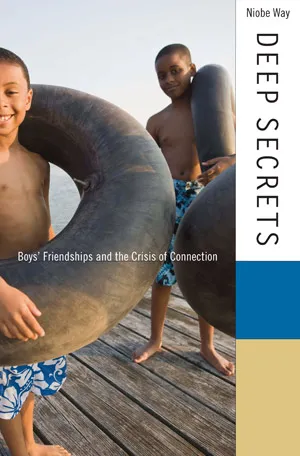
Boys' Friendships and the Crisis of Connection
Niobe Way Deep Secrets: Boys' Friendships and the Crisis of Connection Harvard University Press 326 pages, 5 1/2 x 8 1/4 inches ISBN 978 0674046641
Available here →June 29, 2011
20110629-way-niobe-deep-secrets-boys-friendships-crisis-connection-1
In a nutshell
The rest of this thread

Niobe Way
Niobe Way is Professor of Applied Psychology at New York University, Director of the NYU Developmental Psychology Program, and Co-Director of the NYU Center for Research on Culture, Development, and Education. She is also the President for the Society for Research on Adolescence. Niobe Way received her doctorate from Harvard and was a postdoctoral fellow at Yale. Her research has been funded by the National Institute of Mental Health, The National Science Foundation, The William T. Grant Foundation, The Spencer Foundation, and other foundations. Besides Deep Secrets, featured in her Rorotoko interview, Way is the author of numerous books, including Everyday Courage: The Lives and Stories of Urban Teenagers.
Pull this thread
Adolescent boys have openly intimate male friendships and lose them in late adolescence to culture, not to maturation.
Know something the rest of us don't?
Most threads on Rorotoko begin with our invitation. Any thread can begin with a proposal: you write it with the same prompts every thread answers, and we review it.
Propose a thread →