
Harriet Ritvo
Noble Cows and Hybrid Zebras
When I began work on my first book, animals were not universally acknowledged as respectable subjects of historical research. The book was published by Harvard University Press in 1987, and titled The Animal Estate: The English and Other Creatures in the Victorian Age. One colleague commented that “many weird things have come out of the humanities lately, but this is the weirdest.”
By the time that my next book about animals appeared, The Platypus and the Mermaid, and Other Figments of the Classifying Imagination, also published by Harvard, in 1997, people weren’t saying such things any more, at least not for publication. The significance of animals, both as historical actors on their own account, and as proxies for people, had been well established. And a critical mass of scholars interested in the role of animals has emerged in disciplines from philosophy to sociology.
But much of the value of studying the role of animals from the perspective of the humanities and social sciences comes from their paradoxical position—they are ubiquitous but invisible, essential but unacknowledged, like us but irrevocably different. In consequence, in dealing with animals, whether in words or in actions, people tend to reveal assumptions about each other, as well as about the creatures that are their explicit focus.
Despite its recent growth, the study of the relations between people and other animals is still far from the recognized core of the humanities and social sciences. It remains marginal in most disciplines, and (not the same thing) it is often on the borderline between disciplines. This double marginality allows the study of animals to challenge settled assumptions and relationships—to re-raise the largest issues, both within the community of scholars and in the larger society to which they and their subjects belong.
One of the largest is the definition of “animal” itself. Most scholars who write about such subjects, myself included, think that humans are also animals, and so the focus of our research should be understood as “other animals.” The consequence of this expanded understanding is to eliminate the problematically binary human/animal opposition. But the binary tends to reemerge in several different contexts.
My own work focuses on mammals, in large part because they are most closely associated with people in daily experience and in thought and rhetoric. For example, when Victorian breeders castigated the lasciviousness of their female animals, or bemoaned their reluctance to accept the mates selected for them, they channeled the outrage of the flouted paterfamilias, faced with a daughter who stubbornly insisted on charting her own romantic course—thus conflating the willful maiden with the intransigent mare or bitch.
Other zoological categories—for example crustaceans or nematodes—are incontestably animals, but their relationship to people is very different. While this may not be significant from a biological perspective, it turns out to matter greatly in some practical contexts, such as the persuasive impact of arguments against the mistreatment of animals.
Related problems crop up when the subject of definition is not “animal” but “the animal.” Since the implicit comparison is “the human,” such attempts have the effect, whether intended or not, of reinforcing or resuscitating the human/animal binary.
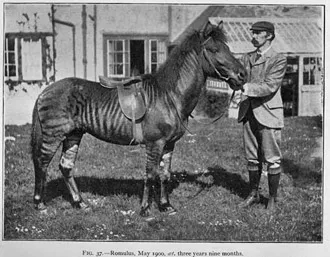
Cossar Ewart and his stud zebra. (Image courtesy of the author’s archive.)
Editor: Erind Pajo
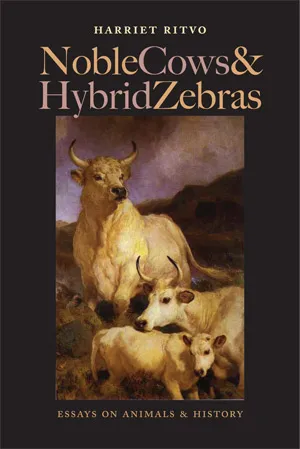
Noble Cows and Hybrid Zebras
Harriet Ritvo Noble Cows & Hybrid Zebras: Essays on Animals & History University of Virginia Press 256 pages, 6 x 9 inches ISBN 978 0813930602
Available here →July 20, 2011
20110720-ritvo-harriet-noble-cows-hybrid-zebras-animals-history-2
The wide angle
The rest of this thread

Harriet Ritvo
Harriet Ritvo is the Arthur J. Conner Professor of History at the Massachusetts Institute of Technology. In addition to the books mentioned in her Rorotoko interview, she is the author of The Dawn of Green: Manchester, Thirlmere, and Modern Environmentalism and the editor of Charles Darwin’s The Variation of Animals and Plants under Domestication, and has published widely on British history, the history of human-animal relations, and environmental history. Harriet Ritvo is a past president of the American Society for Environmental History and a member of the editorial boards of journals in British history, the history of science, and animal studies.
Pull this thread
When people talk about animals they disclose their assumptions about each other.
Know something the rest of us don't?
Most threads on Rorotoko begin with our invitation. Any thread can begin with a proposal: you write it with the same prompts every thread answers, and we review it.
Propose a thread →