
Harriet Ritvo
Noble Cows and Hybrid Zebras
The essays collected in Noble Cows and Hybrid Zebras share a focus on animals but within that general topic, they vary greatly. So a reader most interested in contemporary issues would be drawn first to different selections than would a reader most interested in the history of science.
If I had to choose a single essay that distills the central themes of the book—and that also represents my interest in environmental history—it would be the penultimate essay, “Counting Sheep in the English Lake District.”
Beginning with the foot and mouth epidemic of 2001, which resulted in a widely publicized assault by the British army on the Herdwick sheep who graze unrestrained on the uplands of northwest England, this piece considers how that breed came to symbolize its apparently wild homeland, in preference, for example, to the red squirrel or the otter. This symbolism is multiply complex. Not only are the sheep demonstrably non-indigenous and incontestably domesticated, but their rugged environment also is less wild, or at least more modified by human society and economy, than it appears. Indeed, it has been largely modified by the sheep, who, for the last millennium, have prevented the re-growth of tree cover by their incessant nibbling. So like the sheep, the landscape itself is only wild by assertion and convention; the Herdwicks may after all be its most appropriate representatives.
The issues raised by the historical and contemporary experiences of other animals, and by our understanding of those experiences, have continuing significance.
Often important commitments are expressed in controversies over classification. The most conspicuous such controversy has focused on the position of humans within or without the animal kingdom, especially as demonstrated by Charles Darwin’s theory of evolution by natural selection.
But there are others. The creation and limitation of breeds and the enforcement of breed standards has a clear relation to ideas about the robustness and differentiation of human races. The distinction between domesticated and wild animals is at least equally problematic, and its political implications are more multifarious. Depending on how the opposed elements are valued, it can be used to argue for or against development—for or against conservation.
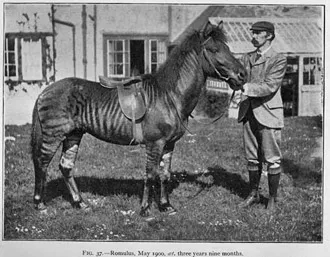
Cossar Ewart and his stud zebra. (Image courtesy of the author’s archive.)
Editor: Erind Pajo
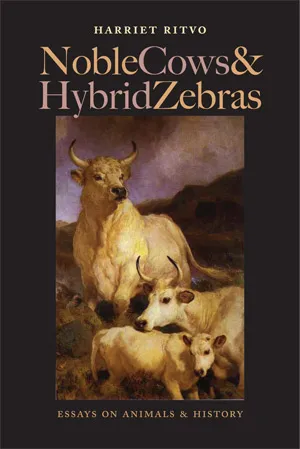
Noble Cows and Hybrid Zebras
Harriet Ritvo Noble Cows & Hybrid Zebras: Essays on Animals & History University of Virginia Press 256 pages, 6 x 9 inches ISBN 978 0813930602
Available here →July 20, 2011
20110720-ritvo-harriet-noble-cows-hybrid-zebras-animals-history-3
A close-up
The rest of this thread

Harriet Ritvo
Harriet Ritvo is the Arthur J. Conner Professor of History at the Massachusetts Institute of Technology. In addition to the books mentioned in her Rorotoko interview, she is the author of The Dawn of Green: Manchester, Thirlmere, and Modern Environmentalism and the editor of Charles Darwin’s The Variation of Animals and Plants under Domestication, and has published widely on British history, the history of human-animal relations, and environmental history. Harriet Ritvo is a past president of the American Society for Environmental History and a member of the editorial boards of journals in British history, the history of science, and animal studies.
Pull this thread
When people talk about animals they disclose their assumptions about each other.
Know something the rest of us don't?
Most threads on Rorotoko begin with our invitation. Any thread can begin with a proposal: you write it with the same prompts every thread answers, and we review it.
Propose a thread →