
Wendy Steiner
The Real Real Thing
Traditionally, the arts have been valued for providing a sphere of imaginary, virtual experience, in contrast to the reality of everyday life. But today, as our profiles and avatars stand for us on the Web and messaging replaces face-to-face contact, everyday life includes virtual experiences of every sort.
It is increasingly difficult to tell where reality leaves off and artifice begins when screens, hype, and imagery permeate every moment of our existence. Under these circumstances, the role of the arts has necessarily been shifting.
The Real Real Thing investigates the situation of the arts when “virtually everything is virtual.” If the abstraction, surrealism, and formalism of the 20th-century avant-garde insisted on art’s contrast to the real, 21st-century artists often see art as a way to reconnect audiences to reality, to provide access to the world outside the work of art.
We can see this tendency in the sudden prominence of nonfiction genres such as documentary, memoir, photojournalism, and portraiture, which until recently had the status of minor or sub-artistic forms. But the most significant symptom of this artistic reorientation is its preoccupation with the figure of the model. In recent literature, film, and visual art, models turn up everywhere.
In the most general sense, a model is an element in reality that an artwork represents.
Mont Ste-Victoire was the model for scores of Cézanne’s paintings—though that mountain had no intention of rendering up its image for art. But human models do. Whether in fashion photography, studio art, or celebrity publicity, models are real people who deliberately simulate the state of an image by posing. They are thus ideal symbols for the intersection of the real and the virtual so common in contemporary life. Susan Sontag wrote that nowadays “to live is also to pose.”
And though Sontag saw our identification with the inanimate image as a social danger, many artists present models quite differently, skillfully reshaping themselves into images as they pose and actively participating in the creation of artworks.
The Real Real Thing describes the innovative ways contemporary artists have developed to communicate the reality of models and their creativity.
Contemporary art shifts the focus of value from the work and its creator onto all parties involved in aesthetic experience. A new politics of art arises in the process. No longer is the real person who posed for a work to be treated as irrelevant to its creation, and no longer are the real people who experience it to be seen as passive recipients of it. In this interactive aesthetics, the roles of model, artist, audience, and artwork reverse and overlap, power circulates freely, and the experiences of empathy, equality, and reciprocity become central values.
Editor: Erind Pajo
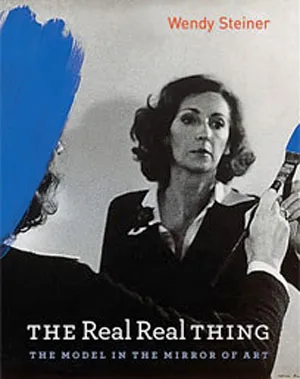
The Real Real Thing
Wendy Steiner The Real Real Thing: The Model in the Mirror of Art University of Chicago Press 240 pages, 7 x 10 inches ISBN 978 0226772196
Available here →August 3, 2011
20110803-steiner-wendy-the-real-real-thing-model-mirror-art-1-1
In a nutshell
The rest of this thread

Michael Ahearn
Wendy Steiner
Wendy Steiner, a Canadian, is the Richard L. Fisher Professor of English at the University of Pennsylvania, where she was Founding Director of the Penn Humanities Forum and past Chair of the English Department. Besides The Real Real Thing, featured in her Rorotoko interview, her many books include Venus in Exile and The Scandal of Pleasure, named as one of the 100 best books by the New York Times (1996). Steiner has created librettos and multi-media productions for two operas, The Loathly Lady (2009) and Biennale (in process), and co-created a real-time music visualization, Traces on the Farther Side (2011).
Pull this thread
Posing is a form of communication, and the model is the central figure of twenty-first-century art.
Know something the rest of us don't?
Most threads on Rorotoko begin with our invitation. Any thread can begin with a proposal: you write it with the same prompts every thread answers, and we review it.
Propose a thread →