
J.C. Sharman
The Despot's Guide to Wealth Management
A basic point of both curiosity and frustration that motivated me to write the book is the difference between rules in the rule-book and what happens in practice. In theory, considering the detailed and exacting international and domestic laws and regulations designed to keep kleptocrats from laundering the proceeds of their corruption abroad, the problem should have been solved.
Yet, year after year, scandal after scandal, the dirty money somehow seems to slip through the net, and corrupt leaders escape accountability. In 2011, the Arab Spring revolutions revealed not just how spectacular the corruption of the former rulers of Egypt, Libya, and Tunisia was, but also how much of this wealth they were able to move into major Western financial centres. Current leaders of highly corrupt African and Central Asian countries continue to live well beyond their means, and both they and their suspiciously bountiful assets travel freely. How can the big gap between what ought to be happening (or ought not to be happening) and the reality be explained, and how can the gap be closed or at least narrowed?
As a student of policy and politics, I wanted to know why the promise of a system that looked so good on paper seemed to be so hard to translate into practice.
This followed earlier research I had done on tax havens and tax evasion, and anti-money laundering more generally. All these problems epitomize challenges of globalization, whereby states and other actors struggle to impose control on an increasingly borderless financial system.
In terms of answering the big questions, I see the new rules against grand corruption as a product of the end of the Cold War and the failure of development policy. The collapse of the Soviet Union undermined the rationale for the US and other Western countries to prop up thoroughly corrupt but staunchly anti-Communist client regimes. At about the same time, the World Bank and other development institutions had to explain why their policy prescriptions had failed to make poor countries richer. Their response was that corruption had prevented development, and thus that to achieve the latter it was necessary to fight the former.
Although there have been some important successes in the fight against grand corruption, overall the results have been disappointing, for a number of reasons. First, international law enforcement and judicial co-operation across borders is just an inherently difficult process, especially when it comes to complex financial crimes. Second, the bureaucratic incentives faced by prosecutors and police favour simple, quick cases with a high probability of success, whereas major cross-border corruption cases are complex, expensive, and drag on for years or even decades. Finally, many key monitoring and enforcement functions have been delegated to banks and other private intermediaries whose interests are often best served by turning a blind eye to clients with suspicious wealth.
Editor: Judi Pajo
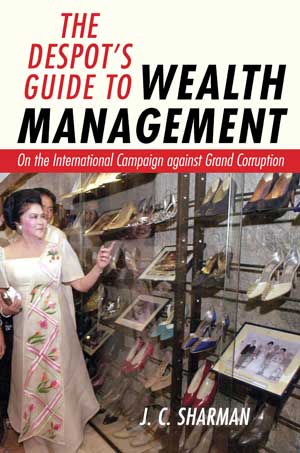
The Despot's Guide to Wealth Management
J.C. Sharman The Despot's Guide to Wealth Management: On the International Campaign against Grand Corruption Cornell University Press 274 pages, 6 x 9 inches ISBN 978 1501705519
Available here →November 20, 2017
20171120-sharman-jc-on-book-despots-guide-wealth-management-international-2-1
The wide angle
The rest of this thread

J.C. Sharman
J.C. Sharman is the Sir Patrick Sheehy Professor of International Relations at the University of Cambridge and a fellow of King’s College. Earlier, he worked at Griffith University, the University of Sydney, and American University in Bulgaria. Sharman’s research is focused on the regulation of global finance, especially in relation to money laundering, tax, corruption and offshore financial centres, and the international relations of the early modern world. His latest books are The Despot’s Guide to Wealth Management (Cornell University Press, 2017), which is featured in his Rorotoko interview, and International Order in Diversity: War, Trade and Rule in the Indian Ocean (Cambridge University Press, 2015).
Pull this thread
The prohibition on hosting kleptocrats' money fails for structural reasons, and the remedy is to recruit the profit motive.
Know something the rest of us don't?
Most threads on Rorotoko begin with our invitation. Any thread can begin with a proposal: you write it with the same prompts every thread answers, and we review it.
Propose a thread →