
Michael J. Ryan
A Taste for the Beautiful
The first two chapters set the stage for understanding how beauty comes to be in the brain of the beholder. I begin Chapter 1 by asking a simple question: Why all the fuss about sex? Why can’t sex happen without all the courtship, seduction, and cajoling? Why have males evolved elaborate colors, dances, odors, and songs to impress females? And why is it that females are usually the ones who decide who gets to mate? Most readers will be amazed to learn the basic answer is that females have fewer, larger gametes and males have many smaller ones. Most of the differences between males and females of most animals are derived from this basic biological difference in gamete size between the two sexes.Now that we know that females are in the driver’s seat when it comes to choosing a mate, in Chapter 2 I explore how it is that the brain perceives beauty. It all starts with biases in the sense organs that determine the sights, sounds, and smells that an animal perceives, and it culminates in the brain where judgments about beauty are made. The brain is important for sex, but it has other things on its mind. I wrap up Chapter 2 by showing the reader how other tasks of the brain, such as the need to detect food and predators, the way sights, sounds, and smells are processed, and the cognitive algorithms used to compare mates, all contribute to the female’s sexual aesthetics, to her taste for the beautiful.In both of these chapters we are introduced to a conundrum that led Darwin to declare, “The sight of a feather in a peacock's tail, whenever I gaze at it, makes me sick!” Darwin had been working on his theory of natural selection, which explains how organisms evolve adaptations for survival. But now he was confronted by the sexual beauty of male animals in which it was clear these traits, like the peacock’s tail, were not tools for survival, but in fact they hindered it. A male peacock extending his tail to its full length and vibrating it in front of the female while courting her looks quite majestic, but when that same male is being chased by a predator he appears quite pathetic and barely even to fly with such a cumbersome accoutrement trailing behind him.Similarly, in the frogs that I study, males add syllables called chucks to the introductory whine of the mating call. Females are attracted to calls that have only whines but they prefer calls with chucks, the more chucks the better. Why don’t males always produce calls with more chucks?We discovered that the fringe-lipped bat eats frogs and finds them by homing in on the frog’s mating call. Like the female frogs, the frog-eating bats are attracted to calls that contain only whines, but prefer calls with chucks. This illustrates the basic conflict involved in the evolution of sexual beauty: natural selection favors traits that enhance survivorship, while sexual selection favors traits that enhance sexual attraction. The result is usually some compromise between the two.Beauty is all around us and it is intoxicatingly diverse. Much of this diversity exists because beauty enters our sexual brain through different sensory modalities, which strains our ability to make comparisons: we cannot objectively rank the beauty of a dance, a song, and a fragrance. The diversity of beauty is no less astounding within a single sensory domain—the collage of colors of many fishes and the vocal repertoires of songbirds are both overwhelming. The existence of all this diversity makes it obvious that there is no single platonic ideal of beauty. This is true within our own species and also amongst the hundreds of thousands of species that reproduce sexually. The diversity of beauty springs from the diversity in how different species and even individuals of the same species sense the world around them. Our sexual aesthetics, those of humans and other species, are not handed down from above but are generated from within, specifically from within our brains. We are the ones who define beauty, and understanding the existence of beauty as well as our taste for it is not possible without viewing beauty through the brain of the beholder.Of course, beauty is not restricted to sexual beauty. The perspective I present here also leads us to wonder how the idiosyncrasies and quirks in our own brains influence our own appreciation of a work of art, a field of flowers, or an expertly executed move on the football field. Might any of these percepts of beauty be a side-effect of our sexual aesthetics? Or, alternatively, can our appreciation of beauty in other domains influence what we find to be sexually beautiful? What is it about our senses, our brains, and our cognitive architecture that gives us an appreciation for beauty all around us? Why does beauty matter so much?Like Darwin, we will continue to be confounded by aspects and elements of beauty as we encounter them, but we have come to understand so much more about the evolution of beauty since his time. As scientific exploration continues, we are sure to expand even further our ability to see the ways that beauty is woven into existence, the many forms it assumes, and the wild appreciations it elicits.
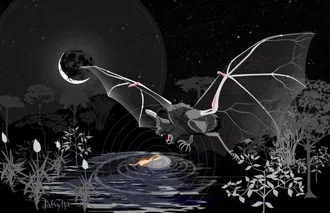
Illustration by Daymond Kyllo.
Editor: Judi Pajo

A Taste for the Beautiful
Michael J. Ryan A Taste for the Beautiful: The Evolution of Attraction Princeton University Press208 pages, 6 x 9 1/4 inches ISBN 978 0691167268
Available here →January 8, 2018
20180108-ryan-michael-on-book-taste-beautiful-evolution-attraction-3-1
A close-up
The rest of this thread
.webp)
Merlin Tuttle
Michael J. Ryan
Michael J. Ryan is the Clark Hubbs Regents Professor in Zoology at the University of Texas, Austin, and a Senior Research Associate at the Smithsonian Tropical Research Institute in Panama. Ryan received his Bachelor’s degree at Glassboro State College, his MS at Rutgers University, his PhD at Cornell University, and was a Miller Postdoctoral Fellow at the University of California, Berkeley. Ryan is a fellow of the American Academy of Arts and Sciences, the American Association for the Advancement of Science, the Guggenheim Foundation, and the Institute of Advanced Studies in Berlin.
Pull this thread
Sexual beauty is a property of the female brain judging it, not of the ornament.
Know something the rest of us don't?
Most threads on Rorotoko begin with our invitation. Any thread can begin with a proposal: you write it with the same prompts every thread answers, and we review it.
Propose a thread →