
Peter T. Leeson
WTF?! An Economic Tour of the Weird
At each exhibit, you’ll learn about a different seemingly insane ritual used to organize human life and learn a different lesson about how to use economic logic to find its underlying sanity. Take, for instance, judicial ordeals: For more than 400 years, between the ninth and the early thirteenth centuries, European legal systems adjudged the guilt or innocence of criminal defendants by asking them to plunge their hands into a cauldron of boiling water to pluck out a ring. In these ordeals, a priest asked God to let the water burn the defendant’s hand if he were guilty and to perform a miracle that prevented the water from burning his hand if he were innocent. Confidence that God would fulfill the priest’s request reflected a popular belief according to which ordeals were iudiciua Dei—”judgments of God.”
On the surface, ordeals seem, well, stupid. But think about them for a moment using economic logic—in terms of incentives…Suppose you’re a medieval European who’s been accused of stealing your neighbor’s cow. The court orders you to the ordeal. Like other medieval Europeans, you believe in iudicium Dei—that a priest, through the appropriate rituals, can get God to reveal the truth, performing a miracle that prevents the water from burning you if you’re innocent, letting you burn if you’re not.
If you undergo the ordeal and God says you’re guilty, you have to pay a large fine. If He says you’re innocent, you’re cleared of the charge and pay nothing. Alternatively, you can avoid undergoing the ordeal by confessing to having stolen the cow. If you confess, you pay a fine, but a smaller one since you came clean.
What will you do? Suppose you’re guilty: You know you stole your neighbor’s cow, and so does God. In this case, you expect that if you undergo the ordeal, God will let the boiling water burn you, evidencing your guilt. Thus, you’ll have to pay the large fine, and you’ll have your hand boiled to rags, to boot. In contrast, if you confess, you’ll save a bit of money, not to mention your hand. So, if you’re guilty, you’ll confess.
Now suppose you’re innocent: You know you didn’t steal your neighbor’s cow and, again, so does God. In this case, you expect that if you undergo the ordeal, God will perform a miracle that prevents the boiling water from burning you, evidencing your innocence. Thus, you won’t have to pay any fine, and you’ll keep your hand intact. In contrast, if you confess, you’ll have to pay a fine for a theft you didn’t commit. So, if you’re innocent, you’ll undergo the ordeal.
Are you staring to see the logic? Because of your belief in iudicium Dei, the specter of the ordeal leads you to choose one way if you’re guilty—confess—and another way if you’re innocent—undergo the ordeal—revealing the truth about your criminal status though the choice you make. By asking God to “out” you, the legal system incentivizes you to “out” yourself! I know what you’re thinking: “But the water will still boil everyone who sticks their hand in it!” And you’re right—if the water is actually boiling. But it wasn’t; to find out how and why, you’ll have to take the tour, where this and umpteen other questions that just occurred to you about ordeals are answered.
Suppose you see a woman standing in front of a wall with a picture frame by her feet. She’s holding a high-heeled shoe in her hand, which she’s banging against the wall. It’s pretty obvious that she’s trying to hang the picture, but why is she using a high-heeled shoe? One possibility: the woman is irrational. A hammer is the best tool for hanging pictures, but she’s sledging away with stilettos nonetheless; what a dunce!—pardon me, “behaviorally biased agent.” Another possibility: the woman is using her shoe to hang the picture because there’s something about her environment that, oddly enough, makes her shoe the best tool for the job. For example, she doesn’t happen to have a hammer lying around but does happen to be wearing high-heeled shoes.
There’s a good chance that you’ve encountered someone doing something similar in your own life; perhaps it was even you. Because of this, it’s easy to see the logic in the woman’s superficially silly behavior. But what if you didn’t have first-hand experience to draw on—say, like publicly auctioning off your spouse? What if you were 500 years removed from the behavior that sounded downright dumb—say, like suing crickets for trespass? What if the context was foreign, making it nearly impossible to guess the environmental particulars at play—say, like using trial by poison ingestion to determine accused criminals’ fate? You’d probably fall back on the excuse that’s easy, and obvious, and wrong: people are irrational.
The purpose of WTF?! is to gird against this fate—to help us learn how to see the logic in human behavior that often seems totally illogical. If we can do that, we have a better chance of understanding each other and people, past and present, who seem so different from us but are really not so different at all.
Editor: Judi Pajo
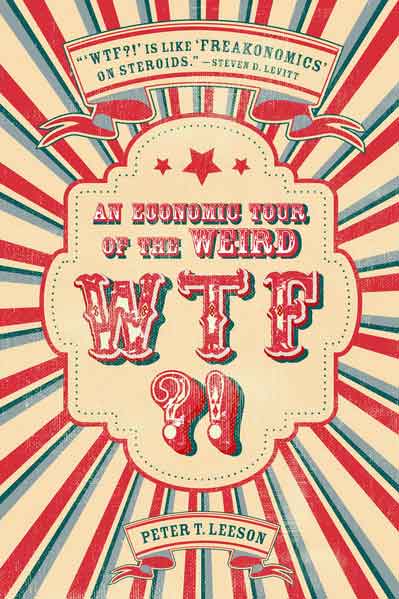
WTF?! An Economic Tour of the Weird
Peter T. Leeson WTF?! An Economic Tour of the Weird Stanford University Press 264 pages, 6.2 x 9 inches ISBN 978 1503600911
Available here →February 26, 2018
20180226dd-leeson-peter-on-book-wtf-economic-tour-weird-3-1
A close-up
The rest of this thread

Peter T. Leeson
Peter T. Leeson is the Duncan Black Professor of Economics and Law at George Mason University. He is author of the award-winning The Invisible Hook: The Hidden Economics of Pirates (Princeton, 2009) and WTF?! An Economic Tour of the Weird (Stanford, 2017). Leeson was a Visiting Professor of Economics at the University of Chicago, Visiting Fellow in Political Economy and Government at Harvard University, and the F.A. Hayek Fellow at the London School of Economics. Big Think listed him among “Eight of the World’s Top Young Economists.” He is a Fellow of the Royal Society of Arts.
Pull this thread
Humanity's weirdest rituals, like trial by ordeal, were clever solutions to real problems.
Know something the rest of us don't?
Most threads on Rorotoko begin with our invitation. Any thread can begin with a proposal: you write it with the same prompts every thread answers, and we review it.
Propose a thread →