
Peter T. Leeson
WTF?! An Economic Tour of the Weird
WTF?! is a tour through a museum of the world’s weirdest practices—guaranteed to make you say, “WTF?!” Did you know that “preowned” wives were sold at auction in nineteenth-century England? That today, in Liberia, accused criminals sometimes drink poison to determine their fate? How about the fact that, for 250 years, Italy criminally prosecuted cockroaches and crickets? Do you wonder why? Then this tour is just for you!
You’ll be joined on the tour by a cast of colorful characters, led through the museum by me—your tour guide and resident economist. From one exhibit to the next, you’ll overhear my exchanges with the other tour-goers and learn how to use economic thinking to reveal the hidden sense behind seemingly senseless human behavior—including your own. I’ll show you that far from “irrational” or “accidents of history,” humanity’s most outlandish rituals are in fact ingenious solutions to pressing problems—developed by clever people, driven by incentives, and tailor-made for their time and place.
Editor: Judi Pajo
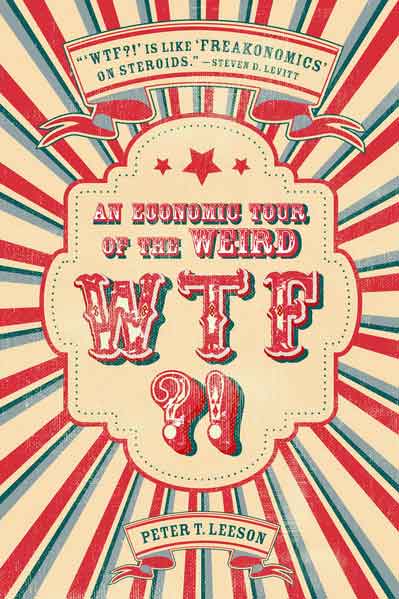
WTF?! An Economic Tour of the Weird
Peter T. Leeson WTF?! An Economic Tour of the Weird Stanford University Press 264 pages, 6.2 x 9 inches ISBN 978 1503600911
Available here →February 26, 2018
20180226dd-leeson-peter-on-book-wtf-economic-tour-weird-1-1-1
In a nutshell
The rest of this thread
Peter T. Leeson
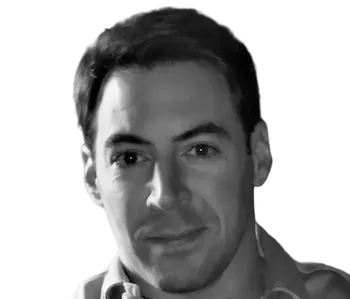
Peter T. Leeson is the Duncan Black Professor of Economics and Law at George Mason University. He is author of the award-winning The Invisible Hook: The Hidden Economics of Pirates (Princeton, 2009) and WTF?! An Economic Tour of the Weird (Stanford, 2017). Leeson was a Visiting Professor of Economics at the University of Chicago, Visiting Fellow in Political Economy and Government at Harvard University, and the F.A. Hayek Fellow at the London School of Economics. Big Think listed him among “Eight of the World’s Top Young Economists.” He is a Fellow of the Royal Society of Arts.
Pull this thread
pulls againstpulls alongside
Judicial ordeals worked because defendants believed in them, and the water was not actually boiling.
Against PG · Modern money is bank credit, therefore debt, and debt has replaced God as the guarantee of human cooperation. On: Human conduct is well modelled as self-interested calculation of costs and benefits
Against TM · The welfare queen survives because stories demand antagonists, detail and resolution, and only better-told stories can dislodge her. On: A practice that persists over long periods does so because it works
Against AS · A social worker's finding of neglect is as factual as a doctor's reading of a blood-pressure number. On: Human conduct is well modelled as self-interested calculation of costs and benefits
Against RL · People diagnosed with psychopathy are not meaningfully more violent than other offenders, and the diagnosis should leave legal use. On: A practice that persists over long periods does so because it works
Alongside JS · The prohibition on hosting kleptocrats' money fails for structural reasons, and the remedy is to recruit the profit motive. On: Human conduct is well modelled as self-interested calculation of costs and benefits
Alongside EB · Mutual-aid structure makes radical religious groups lethal, so governments should compete with them in providing benign services. On: A practice that persists over long periods does so because it works
Alongside EP · States punish violators of international law badly, so they violate it with impunity when benefits exceed costs. On: Human conduct is well modelled as self-interested calculation of costs and benefits
Alongside AK · The Cuban Revolution survived on loyalty generated by cubanía, the belief in an independent and socially just Cuba. On: A practice that persists over long periods does so because it works
Know something the rest of us don't?
Most threads on Rorotoko begin with our invitation. Any thread can begin with a proposal: you write it with the same prompts every thread answers, and we read it.
Propose a thread →