
Peter T. Leeson
WTF?! An Economic Tour of the Weird
What’s the dumbest social ritual you’ve partaken in? Fraternity hazing, perhaps? Or maybe debating a lunch mate over who gets the privilege of picking up the tab? How about pretending that the style of eggs you had for breakfast is must-share news for social media? Not bad—those all seem pretty dumb—but take a moment to ponder these beauties: Deciding criminal defendants’ guilt or innocence by seeing how their hands react to being plunged into a cauldron of boiling water. Consulting a poisoned chicken to decide how to behave toward your neighbors. Adjudging land disputes by having litigants’ legal representatives club one another before an arena of spectating citizens. Each of these practices lasted for over a hundred years—sometimes hundreds of years—and they’re just the tip of humanity’s seemingly-stupid-social-ritual iceberg. Kind of makes posting your croissant on Facebook seem, well, reasoned.
So what’s the deal with the silly stuff people do? How do we explain it? Are people just dumb—pardon me, “irrational”?That’s one theory, and it offers the kind of excuse that’s easy to reach for when we encounter practices that strike us as stupid: People behave in ways that seem senseless because people are senseless. There’s even scholarship to make us feel better about thinking this way—experiments involving coffee cups, college students and “games” of this or that, which suggest that people aren’t so great at making decisions; often, they’re pretty damn bad. Case closed! Right? Not so fast. Is it so clear that people’s bad decisions are actually “bad”? Are coffee-cup experiments with college students really so convincing?? Could entire societies, for centuries, have just been banging their collective heads against the proverbial wall??? Call me irrational, but I vote no. People make plenty of mistakes—just flip through an old family photo album for proof. And sometimes the institutions people develop are downright destructive—a fact worth remembering as we mark the hundredth anniversary of the Bolshevik Revolution. But the same species built the ancient pyramids, created the common law, and gave us Game of Thrones—our species.
There’s another theory—one that explains mankind’s seemingly senseless social rituals—and according to it, lurking beneath the craziness, there’s actually a good deal of sense. I call this theory “rational choice,” but don’t get hung up on the name. “Rational” doesn’t mean omniscient; it doesn’t even mean well-informed. It simply means that people have goals, which they pursue as best they can given the limitations they face. In this alternative theory, those limitations—the particular features of people’s environments—account for their practices that sometimes seem stupid. The particular features of people’s environments shape the incentives they face, and the incentives people face shape their behavior. At root, rational choice theory is just about thinking in terms of these incentives—thinking “economically”—and this is the approach WTF?! uses to find the sense in seemingly senseless practices.
Editor: Judi Pajo
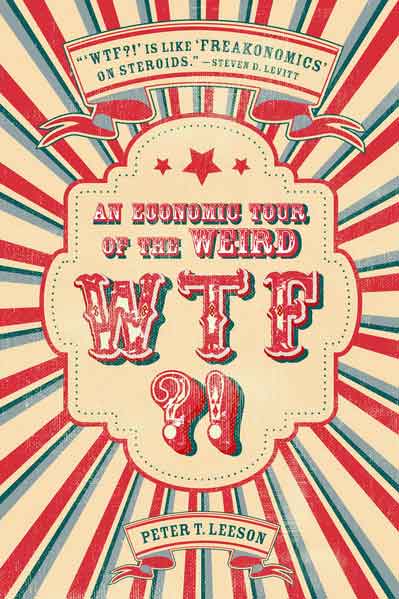
WTF?! An Economic Tour of the Weird
Peter T. Leeson WTF?! An Economic Tour of the Weird Stanford University Press 264 pages, 6.2 x 9 inches ISBN 978 1503600911
Available here →February 26, 2018
20180226dd-leeson-peter-on-book-wtf-economic-tour-weird-2-1
The wide angle
The rest of this thread
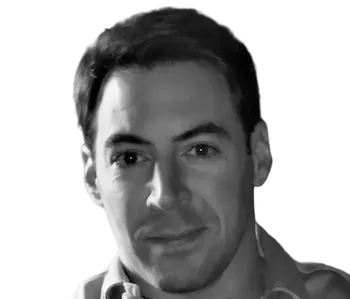
Peter T. Leeson
Peter T. Leeson is the Duncan Black Professor of Economics and Law at George Mason University. He is author of the award-winning The Invisible Hook: The Hidden Economics of Pirates (Princeton, 2009) and WTF?! An Economic Tour of the Weird (Stanford, 2017). Leeson was a Visiting Professor of Economics at the University of Chicago, Visiting Fellow in Political Economy and Government at Harvard University, and the F.A. Hayek Fellow at the London School of Economics. Big Think listed him among “Eight of the World’s Top Young Economists.” He is a Fellow of the Royal Society of Arts.
Pull this thread
pulls againstpulls alongside
Judicial ordeals worked because defendants believed in them, and the water was not actually boiling.
Against PG · Modern money is bank credit, therefore debt, and debt has replaced God as the guarantee of human cooperation. On: Human conduct is well modelled as self-interested calculation of costs and benefits
Against TM · The welfare queen survives because stories demand antagonists, detail and resolution, and only better-told stories can dislodge her. On: A practice that persists over long periods does so because it works
Against AS · A social worker's finding of neglect is as factual as a doctor's reading of a blood-pressure number. On: Human conduct is well modelled as self-interested calculation of costs and benefits
Against RL · People diagnosed with psychopathy are not meaningfully more violent than other offenders, and the diagnosis should leave legal use. On: A practice that persists over long periods does so because it works
Alongside JS · The prohibition on hosting kleptocrats' money fails for structural reasons, and the remedy is to recruit the profit motive. On: Human conduct is well modelled as self-interested calculation of costs and benefits
Alongside EB · Mutual-aid structure makes radical religious groups lethal, so governments should compete with them in providing benign services. On: A practice that persists over long periods does so because it works
Alongside EP · States punish violators of international law badly, so they violate it with impunity when benefits exceed costs. On: Human conduct is well modelled as self-interested calculation of costs and benefits
Alongside AK · The Cuban Revolution survived on loyalty generated by cubanía, the belief in an independent and socially just Cuba. On: A practice that persists over long periods does so because it works
Know something the rest of us don't?
Most threads on Rorotoko begin with our invitation. Any thread can begin with a proposal: you write it with the same prompts every thread answers, and we review it.
Propose a thread →