
Valerie Olson
Into the Extreme
I was a graduate student at Rice University in Houston Texas when the space shuttle Columbia disintegrated overhead as it was returning to Earth. I watched communities in and around Houston go into grief and shock, and I tracked news from NASA as it grounded its fleet and investigated the accident. This compelled me to seek an understanding of the complex hidden worlds of spacefaring. I ended up going into places that have been prohibited to outsiders, and spending time with people who are trying to create the connections, separations, and artificial environments that keep living things alive in spaces beyond Earth.
So, what are spaceflight-based ways of thinking and building? I was curious about spaceflight’s most quotidian and far-out environmental systems work. My book begins with underwater “space analog” training missions that draw the sea and outer space together. It goes into space biomedicine networks, where astronauts are managed as one among other systemic parts of a larger mission system. I examine how spacesuit and space habitat design problems force engineers and architects to challenge cultural ideas about the “natural” boundaries between bodies and spaces. I end by examining how new attempts to manage “space weather” (asteroids, solar radiation) extends global economic and environmental politics beyond Earth’s atmosphere.
In NASA, every kind of thing, from a human body to a spacecraft to a galaxy is described as a system within a broader system. The spaces that matter to keeping humans alive in space, like the tiny space between one cell and another, or the incomprehensible expanses of galactic and intergalactic space, are understood to be environments.
In this way, spaceflight systems work has both a conceptual and political impact: it authoritatively universalizes a way of thinking about relations and spaces. The book calls attention to Western cultural conceits about human exceptionalism and boundaries, and also to the ways that spaceflight programs in and out of the U.S. produce new ways to the relational interdependence of living and nonliving things.
Editor: Judi Pajo
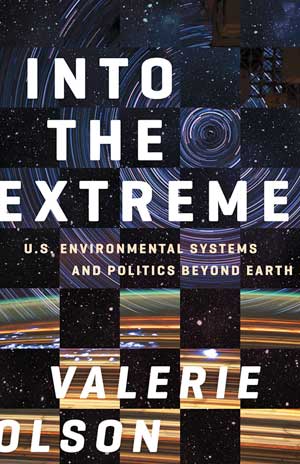
Into the Extreme
Valerie Olson Into the Extreme: U.S. Environmental Systems and Politics beyond Earth University of Minnesota Press 280 pages, 5 1/2 x 8 1/2 inches ISBN 978 1517902544
Available here →July 1, 2018
20180625-olson-valerie-on-book-into-extreme-us-environmental-systems-2-1
The wide angle
The rest of this thread
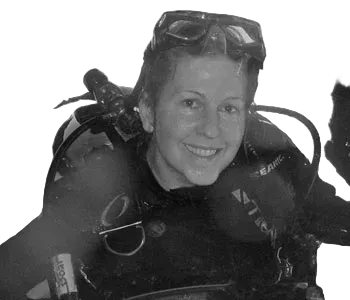
Valerie Olson
Valerie Olson is Associate Professor of Anthropology at UC Irvine.
Pull this thread
pulls againstpulls alongside
US human spaceflight is the work of extending Western concepts of system and environment into the solar system.
Nearby HC · There is no scientific method, and invoking one as the guarantor of expertise now does more harm than good.
Nearby JB · Energy's worth depends on its entropy, so a kilowatt hour of electricity and one of gas are different goods.
Nearby PE · There is no such thing as raw global climate data.
Know something the rest of us don't?
Most threads on Rorotoko begin with our invitation. Any thread can begin with a proposal: you write it with the same prompts every thread answers, and we review it.
Propose a thread →