
Valerie Olson
Into the Extreme
I hope the reader will thumb through the book and check out the images and illustrations. U.S. human spaceflight is both a civil and a military activity, which means that it produces images that are offered to the public at large as well as images that are kept secret. I included lots of fair access images that call attention to the stolidly technical and extravagantly creative spectrum of government environmental systems work.While browsing through the book, I hope readers will also take a look at the quotes I got from the many people I worked with and interviewed. Spaceflight stories are usually focused on high-profile machines, astronauts, and events. As an ethnographer, I’m also interested in portraying the work of the spaceflight scientists, engineers, technicians, and student interns who show up at the gates of spaceflight centers every day.I had, literally, thousands of images, to choose from and hundreds of pages of interviews and fieldwork notes to build this book from; I selected those that I felt would support my analytic goals, namely to call attention to the ways the contemporary solar system is being produced as a sociocultural, and political, environment. In this way, I situate space and spaceflight in the unfolding arenas of environmental history and politics.Formaly speaking, this book is about spaceflight as a form of national environmental power. But it is also a story about a far-flung network of people who socialize and act politically in terms of systems and environments. Taken together and at large, the concepts of system and environment are sentinel Western symbols and tools. They have been deployed to build weapons of mass destruction, to govern colonized peoples, to manage institutions, and also to invent the discipline of ecology. They structure debates about how to understand the semi-closed environmental dimensions of Earthbound life, and also how to build ships to leave this Earth forever. I want readers to see spaceflight as one among lots of kinds of work being done to know and manage environmentally-defined space.People ask me if I’m for or against the system idea, but I didn’t do this project in order to celebrate or debunk the concept or to provide an alternative. Rather, I wrote this book to generate an informed discussion about where the concept came from, who is empowered to do systems work, and how that work is done. The system concept can draw people together or keep them apart, depending on the ways in which it is imagined to be more or less closed or open. And there are other forms of cultural knowledge about interdependent relations, such as those found in Buddhist theories of non-self and non-separation, which provide socially inclusive ethical rubrics that the system concept lacks. I hope the book generates debate about all kinds of relational ideas and their compatibilities and incompatibilities.People also expect me to weigh in on the value of human spaceflight, but this is an issue I simply hope to open to new attention. Spaceflight’s future in the U.S. is uncertain, and people continue to argue about whether it is right or wrong; in any case, it is a persistently charismatic social practice, and as an anthropologist, my aim is to critically and compassionately represent forms of social practice. While U.S. spaceflight furthers imperial goals and scientific cultures, it cannot be reduced to them. It is a sector of the U.S. workforce that includes an aging governmental population, but that is also attracting young workers to private enterprises focused on dreams of otherworldly life. There are people who pursue spaceflight to enhance social liberation and environmental integration, as well as to build colonial economies. The complexities of U.S. spaceflight lie in its sociocultural as well as technical systematicities.According to people I met during fieldwork, humans already live in outer space because their planet is in outer space — so going further is not going outside where we live. This is hard to disagree with in principle, but what it points to, and what I hope the book conveys, is something more fundamental: that it is of crucial importance how social groups organize around senses of being related and of living in an unbounded world.
Editor: Judi Pajo
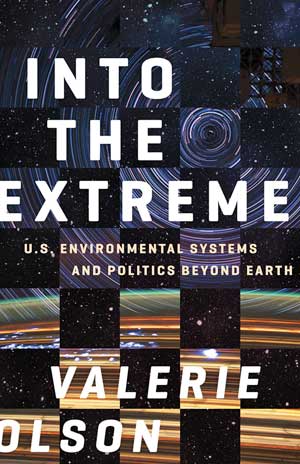
Into the Extreme
Valerie Olson Into the Extreme: U. S. Environmental Systems and Politics beyond Earth University of Minnesota Press280 pages, 5 1/2 x 8 1/2 inches ISBN 978 1517902544
Available here →July 1, 2018
20180625-olson-valerie-on-book-into-extreme-us-environmental-systems-3-1
A close-up
The rest of this thread

Valerie Olson
Valerie Olson is Associate Professor of Anthropology at UC Irvine.
Pull this thread
US human spaceflight is the work of extending Western concepts of system and environment into the solar system.
Know something the rest of us don't?
Most threads on Rorotoko begin with our invitation. Any thread can begin with a proposal: you write it with the same prompts every thread answers, and we review it.
Propose a thread →