
Tim Lomas
Translating Happiness
The book offers, using a cartographic metaphor, a ‘map’ of wellbeing. In that respect, I don’t have a particular preference for which ‘region’ I would hope a reader first encounters. People differ in their tastes and interests, and as a result will naturally be drawn to particular realms of experience. So, I’d invite readers to dive right into the area that intrigues them the most, be this positive emotions, ambivalent emotions, love, prosociality, character, or spirituality. Of course, there is a certain sequential form to the book. The first chapter in particular sets out the groundwork for the narrative as a whole, as it introduces the concept and significance of untranslatable words, and their role in helping augment our maps. However, the chapters can and do stand on their own terms, and so do not have to be read in sequence. Follow your heart, and embrace whichever territory calls out to you most!
The text allows us to drill down into given topics. In the chapter dealing with spirituality, for example, I suggest that across the wealth of words developed in this arena, these fall into three main broad themes: conceptions of the sacred, contemplative practice, and experiences of self-transcendence. This thematic analysis then gives rise to a broad conceptualization of spirituality that may hold across traditions, namely, engagement with the sacred, usually through contemplative practice, with the ultimate aim of self-transcendence.
Furthermore, in the subsection on self-transcendence, I focus quite heavily on Buddhism, since this tradition features strongly in my lexicography – mainly due to personal interest in it, having tried, imperfectly, to develop a Buddhist practice over the last 10 years, but also because Buddhism has developed especially detailed theories of self-transcendence. Below, then, is a sample of text in which I start to introduce one particular Buddhist theory and practice of self-transcendence. In the book I then go into more detail about this theory and practice, before concluding the chapter with another segment of text on the broader significance of self-transcendence, which is also included below.
One representative approach is that of the five skandhas. Translatable as “aggregates” or “heaps,” this term refers to the corporeal elements of the person, substances such as flesh and bone, and processes such as circulation and respiration. By reflecting on these elements in meditation, the practitioner may “deconstruct” her conventional notion of self. The idea is that one comes to appreciate that Buddhist ideas of anātman (no-self) and anitya (impermanence) apply to oneself, and so the immutable self is an illusion. This is not to deny that people actually exist, nor to nihilistically claim that people do not matter, but rather to recognize that the self is an ephemeral mental construct. Similar ideas have been propounded by Western philosophers such as David Hume and William James, who understood the self as an aggregation of successive qualia or “stream of consciousness.” In practice, one reflects on the five skandhas in order to better understand how each, arising in sequence, generates the experience of self....Deep appreciation of the skandhas enables one to see through one’s self-construct and consequently be liberated. This outcome is called sūnyatā. Although often translated as “emptiness,” sūnyatā captures the subtler idea that all phenomena, including the self, are conditional, dependent on conditions and subject to change. As the Heart Sutra memorably puts it, “Form is emptiness and the very emptiness is form.” A person who attains a deep understanding and appreciation of sūnyatā attains enlightenment.
As a final point, some have suggested that sūnyatā would be better translated as openness, boundlessness, or boundarylessness. These terms reflect the notion that human beings tend to perceive, categorize, and experience the world by imposing boundaries on it. This is exactly what languages do, carving up existence into distinctive spheres of experience. This book has made the case that our understanding of life can be enriched if we see how other languages have segmented the world. By doing so, we can refine our maps, adding finer-grained boundaries. Yet, as these forays into Buddhist teaching suggest, we might do even more than refine our maps. By recognizing the constructed nature of our imposed boundaries, we may come to realize that they are useful illusions, that there are no absolute boundaries. This is the essence of sūnyatā: the promise that liberation comes from seeing through the boundaries we have created.
I firmly believe that untranslatable words have the power to uplift and alter our reality in numerous ways. To begin with, they provide a window onto lives in other cultures, revealing something about their traditions, values, and experiences. In this fragmented and divisive age, that kind of empathic connection is vital. But these words are not only valuable in what they tell us about other places, other people. They can also illuminate our own lives, providing us with new language to articulate our experiences. They can even lead us into unglimpsed existential territory, revealing new dimensions of life, of ourselves. So, I would encourage everyone to enquire into this mysterious realm of untranslatability, doing so with a spirit of respect and gratitude for the cultures that created these varied words.
Beyond the book, I hope that readers will take the time to look at the evolving lexicography on my website or on the myriad other website dedicated to this topic. And go further still, chat to people who speak other languages, asking them what discoveries are to be found in their lexicons. You may become transported to new worlds; at the very least you’ll probably have an interesting conversation. Language is a wonderful and mysterious thing, and untranslatable words are among its most profound secrets. A world of discovery awaits.
Editor: Judi Pajo
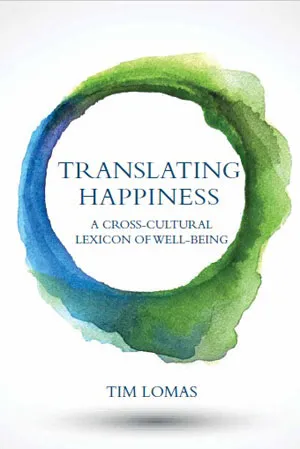
Translating Happiness
Tim Lomas Translating Happiness: A Cross-Cultural Lexicon of Well-Being MIT Press 240 pages, 6 x 9 inches ISBN 978 0262037488
Available here →February 27, 2019
20190227-lomas-tim-on-book-translating-happiness-cross-cultural-lexicon-3-1
A close-up
The rest of this thread

Tim Lomas
Tim Lomas has been a lecturer in positive psychology at the University of East London since April 2013. He completed his PhD at the University of Westminster in 2012, where his thesis focused on the impact of meditation on men's mental health. Since 2013, he has published numerous papers and books on topics including positive psychology theory, mindfulness, Buddhism, linguistics, and gender. His work has been featured in articles in prominent publications including TIME, The New Yorker, Scientific American, and The Atlantic. His current main area of research involves creating a lexicography of untranslatable words relating to wellbeing (see my website for the latest on the project.
Pull this thread
Because psychology is conducted almost entirely in English, it is missing phenomena for which English has no word.
Know something the rest of us don't?
Most threads on Rorotoko begin with our invitation. Any thread can begin with a proposal: you write it with the same prompts every thread answers, and we review it.
Propose a thread →