
Tim Lomas
Translating Happiness
Translating Happiness celebrates the idea that untranslatable words – terms without an exact equivalent in our own language – can expand our emotional, intellectual, and even experiential horizons. Such words represent phenomena or ideas which have been overlooked or underappreciated in one’s own culture, hence the lack of a specific signifier. Crucially though, they have been identified and labelled by another culture, from whom we can learn. These words therefore have the potential to help us better understand and articulate our experiences, providing us with new linguistic tools to make sense of our world. They can even reveal new phenomena, which had previously been veiled to us, pointing us towards realms of life which we had not before noticed.
The book is based on an on-going lexicographic research project, initiated in 2015, to collect and analyze untranslatable words. To limit its scope to a manageable area of enquiry, the project’s focus is on wellbeing, specifically. This is because I am a researcher in positive psychology, which is essentially the scientific study of wellbeing. The lexicography currently comprises over 1,000 words, many of which have been crowd-sourced through generous contributions to a website I created to host the project. My analytical approach to these words has been to explore and organize them thematically. I have identified six main categories, each encompassing many different themes. These are positive emotions, ambivalent emotions, love, prosociality, character, and spirituality. Together, I treat these categories and themes as offering a comprehensive ‘map’ of wellbeing.
The book covers the regions of this map in detail, delving into the various categories and themes by analysing a selection of untranslatable words encompassed within them. The book also looks more generally at the role of language in ‘mapping’ our experience, and the significance of untranslatable words in that respect. In doing so, it also reflects critically on the viability and validity of transposing words and ideas from one cultural context to another. Overall though, it advocates for the idea that cultures can develop and evolve (and always have) by learning from each other. In that respect, the book argues that ‘we’ – readers personally, the field of psychology, and English-speaking cultures more broadly – have much to learn from the ideas and insights developed across the globe.
Editor: Judi Pajo
Translating Happiness
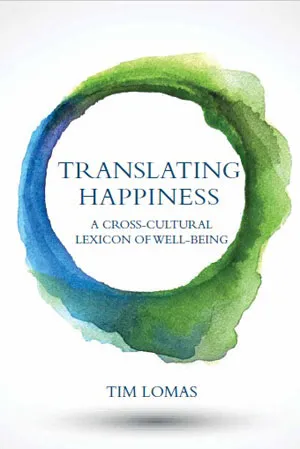
Tim Lomas Translating Happiness: A Cross-Cultural Lexicon of Well-Being MIT Press 240 pages, 6 x 9 inches ISBN 978 0262037488
Available here →February 27, 2019
20190227-lomas-tim-on-book-translating-happiness-cross-cultural-lexicon-1-1-1
In a nutshell
The rest of this thread

Tim Lomas
Tim Lomas has been a lecturer in positive psychology at the University of East London since April 2013. He completed his PhD at the University of Westminster in 2012, where his thesis focused on the impact of meditation on men's mental health. Since 2013, he has published numerous papers and books on topics including positive psychology theory, mindfulness, Buddhism, linguistics, and gender. His work has been featured in articles in prominent publications including TIME, The New Yorker, Scientific American, and The Atlantic. His current main area of research involves creating a lexicography of untranslatable words relating to wellbeing (see my website for the latest on the project.
Pull this thread
Psychology, done almost entirely in English, misses experiences English has no word for.
Know something the rest of us don't?
Most threads on Rorotoko begin with our invitation. Any thread can begin with a proposal: you write it with the same prompts every thread answers, and we review it.
Propose a thread →