
David L. Hu
How to Walk on Water and Climb up Walls
From cave paintings to the anatomical sketches of Leonardo da Vinci, the movement of animals has long fascinated people. Now there is an explosion of new interest and understanding in animal motion. Recent technological developments and the combined interest of computer scientists, physicists, and engineers are enabling us to find new ways to understand how animals can move with such grace and beauty. Understanding how animals move can lead to the development of new kinds of robots and devices, such as crash-resistant drones, robots that walk on water, and exoskeletons that improve the efficiency of walking.
If you have enjoyed watching animals on the Discovery channel, this book will provide a conversational explanation of the things that you see in the show. In the book, I explain the physical principles at work—without it feeling like a full college course.
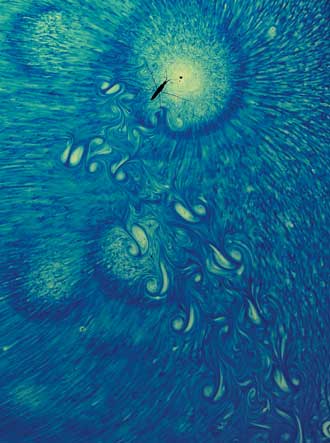
A water strider rows on the water surface, generating an underwater vortex with each stroke. The vortices are made visible by lighting the water from below and the addition of the pH-activated dye, thymol blue.
Editor: Judi Pajo

How to Walk on Water and Climb up Walls
David L. Hu How to Walk on Water and Climb up Walls: Animal Movement and the Robots of the Future Princeton University Press 240 pages, 6 1/8 x 9 1/4 inches ISBN 978 0691169866
Available here →March 27, 2019
20190327-hu-david-on-book-how-walk-water-climb-walls-animal-movement-robots-1-1-1
In a nutshell
The rest of this thread

David L. Hu
David Hu is a mechanical engineer who studies the interactions of animals with water. He has discovered how dogs shake dry, how insects walk on water, and how eyelashes protect the eyes from drying. Originally from Rockville, Maryland, he earned degrees in mathematics and mechanical engineering from M.I.T., and is now Associate Professor of Mechanical Engineering and Biology and Adjunct Professor of Physics at Georgia Tech. He is a recipient of the National Science Foundation CAREER award for young scientists, the Ig Nobel Prize in Physics, and the Pineapple Science Prize (the Ig Nobel of China). He is the author of the book How to Walk on Water and Climb up Walls. His profile is in the New York Times. And he gave a TEDx talk in 2018. He lives with his wife and two children in Atlanta, Georgia.
Pull this thread
Working outdoor robots converge on animal body plans because the physics of sand, water and air imposes unbreakable constraints.
Know something the rest of us don't?
Most threads on Rorotoko begin with our invitation. Any thread can begin with a proposal: you write it with the same prompts every thread answers, and we review it.
Propose a thread →