
David L. Hu
How to Walk on Water and Climb up Walls
The cover of the book is a water strider—an insect that stands on water as if it were land. As the animal rows, it generates waves on the water surface, similar to the ones created when a stone is thrown into a pond. The cover is just the first of several beautiful images featured in the book. The color image section contains a number of award-winning photographs including trout swimming upstream, mosquitoes being struck by raindrops, and ants linking their bodies together to build rafts.
The table of contents includes short striking descriptions of each of the chapters. Swimming under Sand involves the sandfish—a lizard that swims through sand like it is water. Shape of a Flying Snake involves snakes that can spread their ribs like wings to glide through the air. Dead Fish Swimming involves trout that can use their flexible bodies to harvest the energy of rushing rivers so well that even dead fish can swim forward. Are Ants a Fluid or a Solid involves fire ants that can link their bodies together to build waterproof rafts to survive floods. Each of these chapters introduces the physical concepts necessary to understand each of these extraordinary phenomena.
Each chapter introduces the relevant background and can be read independently of the other chapters. I would like the reader to flip through the contents and find a topic that interests them, and then read the chapter. Of course, reading the book from beginning to end works too.
The topics in this book have potential applications in the field of robotics.
Robots have long been relegated to perform repetitive tasks such as assembling parts of a car in factories. In the future, however, robots will leave the factories and enter our everyday lives. Many of the environments that need robots are outdoor environments, such as the open ocean and the sandy surface of Mars. Designing machines to tackle many of these environments can be difficult, due to the physics of the varying medium which still cannot be well predicted on computers.
One shortcut to designing machines that can move with speed and good gas mileage is by looking at how animals move through these environments. To traverse natural terrain, robots may need multiple legs like an insect, or no legs at all like a snake. Robots that successfully traverse outdoor environments are already showing resemblance to the animals that make this place their home. This is because the laws of physics pose unbreakable constraints that influence what kind of motion is most effective.
This book has been a big hit among young audiences. Animal motion is one of the most accessible and interesting subjects around. And it applies to multiple subject areas such as physics, biology, and material science to satisfy anyone’s curiosity. In the book, I spend equal time going through the science behind the discoveries as well as the excitement and thought process of the scientists at work. I hope this book shows that science can be fun and that anyone can be a scientist.
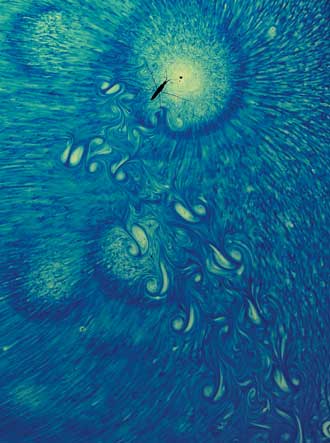
A water strider rows on the water surface, generating an underwater vortex with each stroke. The vortices are made visible by lighting the water from below and the addition of the pH-activated dye, thymol blue.
Editor: Judi Pajo

How to Walk on Water and Climb up Walls
David L. Hu How to Walk on Water and Climb up Walls: Animal Movement and the Robots of the Future Princeton University Press 240 pages, 6 1/8 x 9 1/4 inches ISBN 978 0691169866
Available here →March 27, 2019
20190327-hu-david-on-book-how-walk-water-climb-walls-animal-movement-robots-3-1
A close-up
The rest of this thread

David L. Hu
David Hu is a mechanical engineer who studies the interactions of animals with water. He has discovered how dogs shake dry, how insects walk on water, and how eyelashes protect the eyes from drying. Originally from Rockville, Maryland, he earned degrees in mathematics and mechanical engineering from M.I.T., and is now Associate Professor of Mechanical Engineering and Biology and Adjunct Professor of Physics at Georgia Tech. He is a recipient of the National Science Foundation CAREER award for young scientists, the Ig Nobel Prize in Physics, and the Pineapple Science Prize (the Ig Nobel of China). He is the author of the book How to Walk on Water and Climb up Walls. His profile is in the New York Times. And he gave a TEDx talk in 2018. He lives with his wife and two children in Atlanta, Georgia.
Pull this thread
Robots that work outdoors end up shaped like animals because physics leaves no choice.
Know something the rest of us don't?
Most threads on Rorotoko begin with our invitation. Any thread can begin with a proposal: you write it with the same prompts every thread answers, and we review it.
Propose a thread →