
David L. Hu
How to Walk on Water and Climb up Walls
Understanding animal motion requires application of physics, material science, and robotics.
Take an insect walking on water called the water strider. Its legs are covered in the hairiest surface in the animal kingdom. The 10,000 hairs per square millimeter help trap air bubbles and prevent the legs from getting wet with each stroke. We apply fluid mechanics to understand how the legs can support the strider’s weight and propel it forward. Robotic design is used to build lightweight robots that can walk on water by taking advantage of the size and forces applied by the legs. These robots are given solar panels or other lightweight energy storage devices that enable them to be mass produced and used as cheap ways to monitor the world’s oceans.
When I was a kid I loved going to the zoo and watching animals. When I was admitted to MIT, I learned that the tools of engineering could be useful to understand the amazing things that animals do. I combined this with a PhD in mathematics, and now I run my own laboratory as a professor in both mechanical engineering and biology at Georgia Tech. Our lab studies the design of animals and builds devices based on the things we learn.
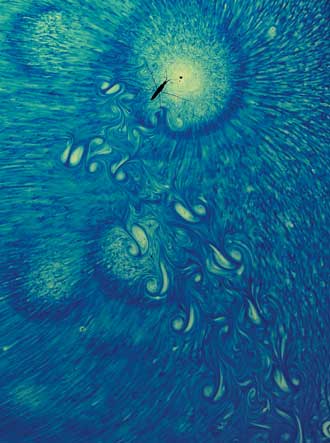
A water strider rows on the water surface, generating an underwater vortex with each stroke. The vortices are made visible by lighting the water from below and the addition of the pH-activated dye, thymol blue.
Editor: Judi Pajo

How to Walk on Water and Climb up Walls
David L. Hu How to Walk on Water and Climb up Walls: Animal Movement and the Robots of the Future Princeton University Press 240 pages, 6 1/8 x 9 1/4 inches ISBN 978 0691169866
Available here →March 27, 2019
20190327-hu-david-on-book-how-walk-water-climb-walls-animal-movement-robots-2-1
The wide angle
The rest of this thread

David L. Hu
David Hu is a mechanical engineer who studies the interactions of animals with water. He has discovered how dogs shake dry, how insects walk on water, and how eyelashes protect the eyes from drying. Originally from Rockville, Maryland, he earned degrees in mathematics and mechanical engineering from M.I.T., and is now Associate Professor of Mechanical Engineering and Biology and Adjunct Professor of Physics at Georgia Tech. He is a recipient of the National Science Foundation CAREER award for young scientists, the Ig Nobel Prize in Physics, and the Pineapple Science Prize (the Ig Nobel of China). He is the author of the book How to Walk on Water and Climb up Walls. His profile is in the New York Times. And he gave a TEDx talk in 2018. He lives with his wife and two children in Atlanta, Georgia.
Pull this thread
Working outdoor robots converge on animal body plans because the physics of sand, water and air imposes unbreakable constraints.
Know something the rest of us don't?
Most threads on Rorotoko begin with our invitation. Any thread can begin with a proposal: you write it with the same prompts every thread answers, and we review it.
Propose a thread →