
Francesco Boldizzoni
Foretelling the End of Capitalism
The first part of the book tells a story of disappointments with our ability to forecast the future of capitalism. This story unfolds in several stages: the Victorian era (Chapter 1), the interwar period (Chapter 2), and the postwar period until the early 1980s (Chapter 3). In the camp of the anticapitalist left, one comes across the betrayed hopes of many old acquaintances, from Karl Marx to Herbert Marcuse. In the conservative and liberal camp, on the other hand, examples range from Friedrich Hayek’s phobia of socialism to Daniel Bell’s moralistic anxieties about the affluent society. In between, one makes more unexpected encounters such as those with John Stuart Mill and John Maynard Keynes.
Chapter 4 continues with an analysis of what has gone wrong with our thinking about the economy and society since the 1990s, a section that could perhaps be of special interest to those who are looking for the roots of the troubled political times we are in. It challenges a number of myths: the myth of the “end of history” and the triumph of the liberal order; the myth that the postindustrial age would erase class conflict and turn workers into high-tech capitalists; the myth that the notions of “left” and “right” have lost their meaning, and so on. The book went to press too early for me to be able to cover the expectations of radical change triggered by the 2020 pandemic, but ample space is devoted to the hopes of seeing capitalism overthrown that followed the global financial crisis at the turn of the 2010s.
To those impatient to reach the book’s conclusions, however, I would suggest focusing on the last two chapters. Chapter 5, a rather disenchanted reflection on the legacy of the Enlightenment, contains the key to all previous chapters. Chapter 6, which I mentioned earlier, seeks on the other hand to answer the questions of what capitalism is, what keeps it alive, and to what extent it can be overcome.
Umberto Eco has shown us that a book can have different implications to different readers, often beyond the author’s intentions. This is perhaps inevitable, but I would nevertheless like to take this opportunity to say two or three things about the spirit in which I wrote it and what I think are the main points to take home.
First of all, this is a book written from the left and to remind the left of its responsibilities. There is not the slightest complacency on my part in narrating the misadventures of thinkers who hoped for a world liberated from capitalism and exploitation—a world in which human beings could be truly free—if anything, there is pain. I sometimes receive interview requests from conservative media eager to use the book’s conclusions to back reactionary agendas. Those looking in it for evidence to legitimize the status quo have taken the wrong direction.
My main point is that capitalism has survived so many predictions of its demise not because it is a particularly efficient system, nor because of some magical virtues of the markets, as the cliché would have it, but because it is rooted in the hierarchical and individualistic structure of modern Western societies. These elements—hierarchies and individualism—have taken shape over many centuries and cannot suddenly go away. No matter how much one fights the system, social institutions cannot be ended by acts of will.
The awareness that there are limits to what can be done, but that at the same time the existing order isn’t a fact of nature but a human construction, leads one to abandon both unhelpful feelings of resignation and pointless utopian fantasies and instead take the path of reasonable political change. The political message of the book is, therefore, an invitation to rediscover and practice radical social democracy. Capitalism can be governed by the state and forced to work to the advantage of the many. It is not an easy road, but one that has proved its value in the past and is worth trying again.
Editor: Judi Pajo
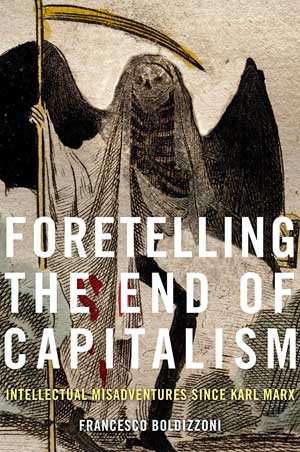
Foretelling the End of Capitalism
Francesco Boldizzoni Foretelling the End of Capitalism: Intellectual Misadventures since Karl Marx Harvard University Press 336 pages, 5 1/2 x 8 1/4 inches ISBN 978 0674919327
Available here →September 16, 2020
20200916-boldizzoni-francesco-on-book-foretelling-end-capitalism-3-1
A close-up
The rest of this thread

Francesco Boldizzoni
Francesco Boldizzoni is Professor of Political Science at the Norwegian University of Science and Technology. He has contributed to several fields across the social sciences, including political theory, political economy, and modern history. In addition to Foretelling the End of Capitalism (Harvard University Press, 2020), which is featured in his Rorotoko interview, he is the author of The Poverty of Clio: Resurrecting Economic History (Princeton University Press, 2011), Means and Ends: The Idea of Capital in the West, 1500-1970 (Macmillan, 2008), and over two dozen of articles and book chapters.
Pull this thread
Capitalism has outlived two centuries of predicted deaths because it is rooted in the hierarchical, individualistic structure of Western societies.
Know something the rest of us don't?
Most threads on Rorotoko begin with our invitation. Any thread can begin with a proposal: you write it with the same prompts every thread answers, and we review it.
Propose a thread →