
Francesco Boldizzoni
Foretelling the End of Capitalism
This book seeks to explain the persistence of capitalism despite all the trouble it has created. For several years now, every crisis—even crises not directly caused by capitalism, such as that of Covid-19—has been accompanied by a plethora of recriminations: capitalism is unsustainable, it cannot go on like this. It makes our societies intolerably unequal, fuels racism, destroys the environment, and so on. Everything will have to change. Thus, expectations of structural change arise which, as soon as the crisis is over, are invariably frustrated.
To make sense of why capitalism is still with us, I perform two separate yet related operations. The first is to review unfulfilled prophecies about its end that have been repeated over the past two centuries. Surprisingly enough, they came not only from the left but also from the right. I endeavor to contextualize them historically but also to identify their mistakes. The idea is that from these mistakes something can be learned, certainly about the limitations of our understanding, but more importantly about capitalism itself. Half of the book can therefore be regarded as a work of history, of intellectual history in the broadest sense.
The second operation is to outline a theory of capitalism and the forces that sustain it. Besides what keeps capitalism alive, a good theory should also explain its origin and, possibly, give us some indication as to where it is or isn’t headed. This part of the work, which is more theoretical in nature, culminates in the final chapter, “How Capitalism Survives.”
I wrote Foretelling the End of Capitalism in such a way that it could be accessible to any intelligent reader, regardless of their background. It’s a book deliberately devoid of jargon, where even important concepts are put into a narrative. This isn’t a work of economics, a discipline that—at least in its present form—has little to say about capitalism, but nor does one have to be a sociologist or philosopher to make the most of it. Any person interested in the subject should be able to read this book, be they dentists or kindergarten teachers. Capitalism touches the lives of us all.
Editor: Judi Pajo
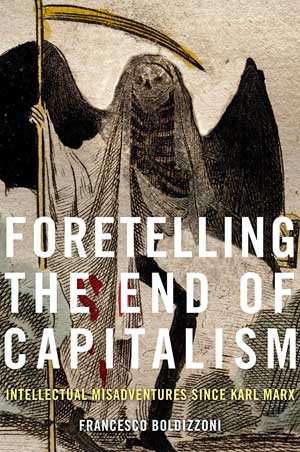
Foretelling the End of Capitalism
Francesco Boldizzoni Foretelling the End of Capitalism: Intellectual Misadventures since Karl Marx Harvard University Press 336 pages, 5 1/2 x 8 1/4 inches ISBN 978 0674919327
Available here →September 16, 2020
20200916-boldizzoni-francesco-on-book-foretelling-end-capitalism-1-1-1
In a nutshell
The rest of this thread

Francesco Boldizzoni
Francesco Boldizzoni is Professor of Political Science at the Norwegian University of Science and Technology. He has contributed to several fields across the social sciences, including political theory, political economy, and modern history. In addition to Foretelling the End of Capitalism (Harvard University Press, 2020), which is featured in his Rorotoko interview, he is the author of The Poverty of Clio: Resurrecting Economic History (Princeton University Press, 2011), Means and Ends: The Idea of Capital in the West, 1500-1970 (Macmillan, 2008), and over two dozen of articles and book chapters.
Pull this thread
Capitalism survives because it is rooted in the hierarchy and individualism of Western societies.
Know something the rest of us don't?
Most threads on Rorotoko begin with our invitation. Any thread can begin with a proposal: you write it with the same prompts every thread answers, and we review it.
Propose a thread →