
Ruth DeFries
What Would Nature Do? A Guide for Our Uncertain Times
The book has separate chapters for each of the four strategies. My favorite chapter is the one about the fourth strategy, titled “One Size Fits No One.” It’s about how nature deals with collective action when a task is too great for a single individual.
Nature’s solution rests on each individual following rules based on its local surroundings. No blueprint or mastermind is required. The strategy gives rise to zebra stripes, ant trails, and termites’ architectural marvels. No central command is directing traffic or commanding the ants and termites where to march or what to do, despite the “queen” misnomer.
In human societies, collective action comes into play in rules and institutions to share water, make laws, trade, and nearly every aspect of organized society. Top-down, central authority with someone setting the rules seems like the logical way to organize society. But nature’s experience suggests otherwise. Bottom-up solutions, organized and implemented by people closest to the ground and the most interest at stake, are messy but can be more effective in the long run than top-down control from a distant authority.
The reason I like this chapter is because the person who brought these ideas to light, although without reference to zebra stripes and ant trails, was about 5 feet tall, treated everyone like she was their grandmother, and went head-to-head against late twentieth-century conventional dogma. The notion of the “tragedy of the commons” dominated development circles and resource managers at the time, inspiring central control and top-down regulations to manage forests, fisheries, and other resources. Elinor Ostrom countered that people can effectively manage their own affairs if given authority and information. Based on decades of on-the-ground work, she showed many examples, from decentralized community policing to water management, where people self-organize. Ostrom won a Nobel Prize for her path-breaking work and died at the age of 78 in 2012.
My aim for the book is to give people some different, perhaps non-intuitive ways of thinking about how we organize ourselves as human societies. I do not mean to be prescriptive and pronounce what “should” or “must” happen. Rather, by thinking about the potential parallels between the two complex systems—nature and human civilization—we might be able to integrate some time-tested examples from nature into our human-constructed institutions.
We live in a time when many people are anxious about the future. Of course, the pandemic is very anxiety-producing. But even without the pandemic, with climate change, political upheavals, and blatant displays of the social inequities that the twentieth century created, people might welcome new ways of viewing the world.
Inventors and architects have highlighted many wonderful examples of biomimicry, such as Velcro inspired by burr spikes and cooling towers pattered on termite mounds. The strategies discussed in the book are more at the level of systems. That means an individual alone can’t unilaterally act on these strategies. A single person cannot build a seed bank, save dying languages, or build redundancy into the global food trade network. I’m afraid this book will not satisfy those who want answers to what they can do individually.
But everyone can be part of a society who chooses its leaders and contributes to decisions about its priorities. We can embrace those leaders who think beyond short-term efficiency, appreciate the power of bottom-up organization, and otherwise might work to implement the strategies from nature that apply to human societies.
When I was researching the examples and stories for the book, I was struck by how many times people have learned through trial and error that nature’s strategies pay off. Most of those examples relate to finance, where portfolio diversity and redundant supply chains are clearly in the interest of stakeholders. But even some examples at a more systems-level, such as the 100-year U.S. Forest Service’s backtrack on Smokey Bear’s message that all fires are bad, show the power of human ability to learn and adjust.
I hope that this book brings optimism and hope that inevitable disruptions need not lead to disaster if society builds nature’s time-tested strategies into its human institutions.
Editor: Judi Pajo

What Would Nature Do? A Guide for Our Uncertain Times
Ruth DeFries What Would Nature Do? A Guide for Our Uncertain Times Columbia University Press 264 pages, 8 5/8 x 5 3/4 inches ISBN 978 0231199421
Available here →January 27, 2021
20210127-defries-ruth-on-book-what-would-nature-do-guide-our-uncertain-time-3-1
A close-up
The rest of this thread
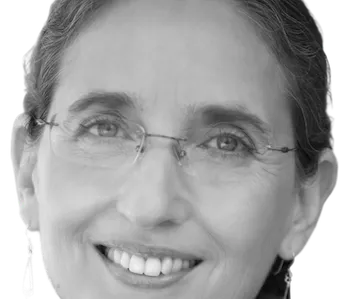
Ruth DeFries
Ruth DeFries is the Denning Family University Professor of Sustainable Development at Columbia University. Her research examines land use changes in the tropics and how it affects climate, biodiversity, and other ecosystem services, particularly in central India. DeFries is a member of the U.S. National Academy of Sciences and received a MacArthur “genius” award among other honors. Her books for popular audiences are The Big Ratchet: How Humanity Thrives in the Face of Natural Crisis and What Would Nature Do? A Guide for Our Uncertain Times, which is featured in her recent Rorotoko interview.
Pull this thread
Ever-greater efficiency is the wrong design goal, and it is what has made modern food, water and supply systems fragile.
Know something the rest of us don't?
Most threads on Rorotoko begin with our invitation. Any thread can begin with a proposal: you write it with the same prompts every thread answers, and we review it.
Propose a thread →