
Karl Gerth
Unending Capitalism
At the heart of Unending Capitalism (and my two other books) is the concept of consumerism. Consumerism—especially compared to identity, race, ethnicity, gender, and class—is underappreciated as a driving force for understanding the twentieth-century world and since, and not just China.
At the founding of the People’s Republic in 1949, China was not mass producing or mass consuming much. But that changed fast. China began to mass produce goods, the lifeblood of industrial consumerism. As China industrialized, consumerism expanded.
China was also under constant assault from foreign powers. As a latecomer to industrial capitalism, China needed to overcome its relative backwardness as fast as possible with state-led industrial capitalism, or “state capitalism.”
Communist Party leaders felt they could not simply rely on markets and private capital to industrialize fast. The state had to set priorities rather than have markets allocate scarce resources.
The state not only prioritized what the country produced but also what and how it consumed. State consumerism is my term to describe the state involvement in all three aspects of consumerism: what got produced and who got it; the ideas associated with mass produced products; and how possession of those things began to define people’s identities. People began to want specific branded products to communicate that they were a rich farmer, a powerful cadre, a successful manager, an intellectual, a city-dweller, or someone who knew how to work the system. My sources show, for instance, that by the late 1960s, there was an elaborate social hierarchy of local, national, and international brands of wristwatches.
In the early years of the PRC, the state was more desperate to maximize labor and minimize consumer desires. However, the state sometimes needed the population to consume. Even in the austere 1950s, as I show in the book, the state promoted Soviet clothing and fashions.
And, as China successfully industrialized, it also promoted consumption of other items as an inducement to work harder. The losers were the same losers they always have been with industrial capitalism everywhere: rural farmers, women, manual laborers, minorities, and so on. And the winners were those in cities, working in state factories, and those working with their heads rather than their hands.
The contradiction between socialist words that sounded egalitarian and capitalist policies that led to inequalities was not lost on the population. My sources told me to doubt the state’s definition of China as “socialist.” So, I go beyond esoteric debates over what is “capitalism” and “socialism” to involve the people living in these countries and how they think. We often assume that people thought whatever the CCP was up to was “socialism” because state sources insist on it—and some of the winners such as those who got the first wristwatches believed it to be so. Instead, I follow my sources and focus on pervasive doubts across the entire society, from Mao Zedong on down, over what the Communist Party was actually building: a state-led version of capitalism, not the socialism of its claims.
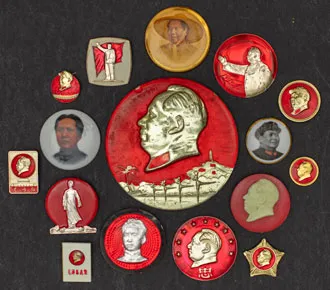
Assortment of Mao badges Collection of Karl Gerth
Editor: Judi Pajo

Unending Capitalism
Karl Gerth Unending Capitalism: How Consumerism Negated China's Communist Revolution Cambridge University Press 394 pages, 6 x 9 inches ISBN 978 0521688468
Available here →March 10, 2021
20210310-gerth-karl-on-book-unending-capitalism-how-consumerism-negated-2-1
The wide angle
The rest of this thread

Karl Gerth
Karl Gerth is Professor of History and Hsiu Endowed Chair in Chinese Studies at the University of California, San Diego. In addition to Unending Capitalism, he is also the author of As China Goes, So Goes the World, which explores whether Chinese consumers can rescue the global economy without exacerbating global problems, and China Made, a history of economic nationalism in China. After receiving his PhD from Harvard in 2000, he taught at the University of South Carolina, Oxford University, and moved to the University of California—San Diego in 2013.
Pull this thread
The People's Republic was a variety of industrial capitalism, and the Communist revolution accelerated capitalism rather than ending it.
Know something the rest of us don't?
Most threads on Rorotoko begin with our invitation. Any thread can begin with a proposal: you write it with the same prompts every thread answers, and we review it.
Propose a thread →