
Richard Scholar
Émigrés
I’d like readers to find their way to the book’s opening page. That page leads into the center of the book’s preoccupations by an indirect route, for it reveals an émigré word at work in the unlikely setting of Winnie-the-Pooh, A. A. Milne’s classic story for children of all ages. Bon-hommy is the French word. I show how it crackles with the energy of a literary work that, in a single sentence, reveals so much about English language and culture in its centuries-old, entangled, relation with French. Here is the page:It is widely to be observed that those wishing, at little effort, to lend a certain intrigue to their English conversation season it with a certain je-ne-sais-quoi or some other soupçon of Gallic garniture. Even the introverted Eeyore, on occasion, reaches for the mot juste. Eeyore is the old grey donkey who lives in a corner of a field that is forever England in A. A. Milne’s stories about Winnie-the-Pooh and friends. In chapter 6 of Winnie-the-Pooh, it is Eeyore’s birthday, a fact that his friends have all forgotten. When Pooh Bear chances upon Eeyore and wishes him a good morning, Eeyore doubts that it is a good morning, hinting darkly: “We can’t all, and some of us don’t. That’s all there is to it.” Pooh asks Eeyore to explain. The old grey donkey offers the following list of equivalent words and phrases: “Gaiety. Song-and-dance. Here we go round the mulberry bush.” A puzzled Pooh asks, “What mulberry bush is that?”, in response to which the donkey merely continues his variations on the theme: “‘Bon-hommy’, went on Eeyore gloomily. ‘French word meaning bonhommy,’ he explained. ‘I’m not complaining, but There It Is.’”Et voila?: There It Is, indeed, the French word that bursts into flower in the midst of the most English sentence. A word of conspicuously French derivation serves Eeyore’s purposes well. It would be too painful for him to name in plain English the simple happiness of being alive that the irrepressible Pooh clearly possesses that morning and which the old grey donkey can’t and doesn’t, at the best of times, but especially when it is his birthday and They have all Forgotten. Instead, Eeyore names obliquely the capacity for happiness that is denied him, alluding to popular English rhymes that speak of it and producing synonyms that name it. He brilliantly introduces the last of these synonyms, bon-hommy, as a French word possessing the meaning of the selfsame word in English. He thereby specifies that meaning as evident to the likes even of Pooh Bear, while using the Frenchness of the word to emphasize its distance from himself, the discontented grey English donkey. His single-word code mixing of French in English at once connects him to, and separates him from, French ways of saying and being.Eeyore’s flourishing of bon-hommy is an act of expressive indirection that reveals much about the history of English in its centuries-old relation with French…Words that cross languages and cultures are my subject. Why concern myself and readers with these? Such words matter to me, not as self-sufficient objects, but for the stories they tell of what it is to live a human life in history and for the role they play in the making of concepts, practices, and forms in and across cultures. I’m endlessly fascinated by these interactions, particularly as these are found in literature, which shapes and is shaped by language, of course, in unique ways.I write not so much in defense as in illumination of French émigré words as they have been received and recycled—used, abused, and reused—in Anglophone culture. I treat the particular words I study in detail—words like caprice, naïveté, and ennui—as points of access into a wider exploration of the processes of translingual and transcultural migration in literature and its sister arts. This, then, is a book about translation and its other. Above all, however, it casts light on those untranslated French words that have ‘turned’ English in their movement between languages and their powers of cultural transformation.We live at a time, of course, when many more English words are ‘turning’ French than the reverse. The historical reasons for this are obvious. After the British empire spread English across the world, the United States entrenched English as a global lingua franca, causing the unprecedented amount of lexical borrowing from English that is currently taking place in French and other languages. The response in the Francophone world to this process of Anglicization is an unresolved mixture of receptivity and resistance. It largely mirrors the Anglophone attitudes I explore in the book towards Frenchification.What I want to suggest to my readers, above all, is that the current dominant position of English in relation to French ought not to be allowed to conceal a longer and more complex story of linguistic and cultural interaction. Anglophones have borrowed words from French for centuries. Why and how they do, and revealing what attitudes in the process towards French and the foreign, are questions at the heart of Émigrés.To existing studies I bring an approach that is innovative, in that it yokes together keywords and creolization, two hitherto unrelated concepts in cultural criticism. When combined with due care, I contend, these concepts make unique sense of the processes that have entangled and enriched English and French language and culture in history. For they show untranslated French words not only ‘turning’ English, but making it anew, causing ambivalence and controversy in the process.The result is an experiment in a cosmopolitan cultural criticism that is sensitive to language, to the vexed social and cultural questions that language raises, and to the dialogue between the arts.I recognize that the book is, in many ways, a caprice. I will leave it to others to judge whether or not it is also a naïveté. Perhaps my greatest hope is that the book does not cause too much ennui.

Ennui depicted as a beer glass half filled with nothing but water. An emblem inspired by the London impressionist Walter Sickert’s 1914 painting Ennui. Illustration by John Barnett in Richard Scholar, Émigrés: French Words That Turned English, p. 130. © Princeton University Press.
Editor: Judi Pajo
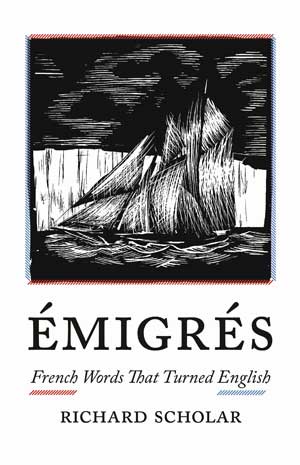
Émigrés
Richard ScholarÉmigrés: French Words That Turned English Princeton University Press272 pages, 5 1/2 x 8 1/2 inches ISBN 978 0691190327
Available here →July 14, 2021
20210714-scholar-richard-on-book-emigres-french-words-that-turned-english-3-1
A close-up
The rest of this thread

Richard Scholar
Richard Scholar is Professor of French at Durham University, a Leverhulme Major Research Fellow, and the author of Émigrés: French Words That Turned English (2020). His other publications include The Je-Ne-Sais-Quoi in Early Modern Europe: Encounters with a Certain Something (2005) and Montaigne and the Art of Free-Thinking (2010). His work has appeared in several languages.
Pull this thread
Untranslated French words like ennui and naïveté are keywords in Raymond Williams's sense, and they entered English by creolization.
Know something the rest of us don't?
Most threads on Rorotoko begin with our invitation. Any thread can begin with a proposal: you write it with the same prompts every thread answers, and we review it.
Propose a thread →