
Richard Scholar
Émigrés
I have long been struck by how much and how deeply English borrows from French. My training was in French and English literature. My first book explored the literary and philosophical history of a single French phrase, the je-ne-sais-quoi, which names—in English as much as in French—a certain something in people or things that we struggle to explain. Working on that phrase up close alerted me to the wider role that French words play in English. I have been wanting to write this book ever since.
The conception of Émigrés owes much (and more than might be imagined) to a 2005 piece in the London Review of Books, by Jenny Diski. Responding to my study of the je-ne-sais-quoi, Diski wrote about the je-ne-sais-quoi she had first encountered as a young woman in 1960s London. Her piece brilliantly demonstrated, in a way I could not have anticipated, that the je-ne-sais-quoi was a modern keyword of a kind that the cultural critic Raymond Williams left underinvestigated.
Williams explored English words, complex in meaning, that relate to what he called ‘the central processes of our common life.’ Williams thinks about language in history and language as history. That was an inspiration to me. But I came to feel that Williams’s pioneering vocabulary of culture and society lacked an entire category, that is, keywords of conspicuously foreign derivation. No vocabulary of English would be complete without them. They include the many migrant French words that we users of English share as we talk about the central processes of our common life.
Perhaps the most surprising discovery in Émigrés, at least to me, was of the colonial histories lurking in the French words that have turned English. These histories may be traced right back to the Norman conquest of England—to 1066 and all that. They have profound implications for the questions we need to ask about our language. They show English being made by mixing with foreign words in a creolizing process connected to colonialism at home and abroad.
Creolization emerged as an important concept in the work of Caribbean intellectuals Édouard Glissant and Stuart Hall. They defined it as a mixing of languages and cultures that takes place amidst highly unequal relations of power such as, primarily, those that existed between African slaves and their European owners on plantations in the Caribbean. Creolization has yet fully to be considered for its shaping of cultural relations within Europe. I start to fill that gap in Émigrés and contribute to the development of creolization as a conceptual model. I examine the case of English and the cultures of the English-speaking world. I explore creolization for what it reveals of migrant French keywords, their controversial histories, and the complex uses to which they are put in the Anglosphere. I show that creolization is well placed to show how the long history of England as colonized and colonizer accompanies the development of English in its entangled relation to French.
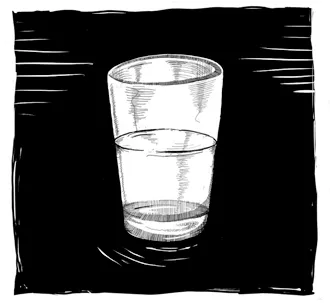
Ennui depicted as a beer glass half filled with nothing but water. An emblem inspired by the London impressionist Walter Sickert’s 1914 painting Ennui. Illustration by John Barnett in Richard Scholar, Émigrés: French Words That Turned English, p. 130. © Princeton University Press.
Editor: Judi Pajo
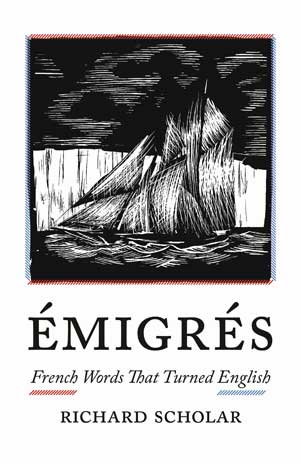
Émigrés
Richard ScholarÉmigrés: French Words That Turned English Princeton University Press 272 pages, 5 1/2 x 8 1/2 inches ISBN 978 0691190327
Available here →July 14, 2021
20210714-scholar-richard-on-book-emigres-french-words-that-turned-english-2-1
The wide angle
The rest of this thread

Richard Scholar
Richard Scholar is Professor of French at Durham University, a Leverhulme Major Research Fellow, and the author of Émigrés: French Words That Turned English (2020). His other publications include The Je-Ne-Sais-Quoi in Early Modern Europe: Encounters with a Certain Something (2005) and Montaigne and the Art of Free-Thinking (2010). His work has appeared in several languages.
Pull this thread
Untranslated French words like ennui and naïveté are keywords in Raymond Williams's sense, and they entered English by creolization.
Know something the rest of us don't?
Most threads on Rorotoko begin with our invitation. Any thread can begin with a proposal: you write it with the same prompts every thread answers, and we review it.
Propose a thread →