
Richard Scholar
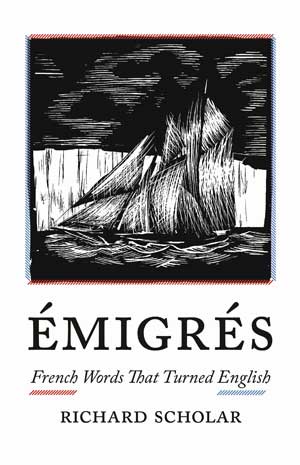
Émigrés
George W. Bush is said to have claimed that “the problem with the French is that they don’t have a word for entrepreneur.” Whether or not it is true, that anecdote illustrates a deeper truth, which is that many in the English-speaking world turn to French more than they would like to think they do.
English has borrowed more words from French than from any other modern foreign language. Many borrowings from French have been seamlessly absorbed into English, like the word entrepreneur. They’ve become part of the fixtures and fittings. Other French borrowings in English leave no room for confusion about their provenance. They assert their identity as French migrants—as émigrés. Think of phrases like je ne sais quoi and à la mode. Phrases such as these and words like naïveté, ennui, and caprice have been widely available in English since the later part of the seventeenth century. They have struck many speakers and writers of English as being uniquely expressive. What role, I wanted to ask, have émigrés played in the making of modern English as it has developed over centuries and as it is spoken and written all over the world today?Émigrés is my answer to that question.
The book explores the emergence in Restoration English of particular émigré words and phrases. It traces the later trajectories of these words across the English-speaking world. It reveals how such émigrés inspire receptivity in some Anglophones, resistance in others, and ambivalence in most. It shows how they can occasion extraordinary creativity even as they remain visibly caught up in a power relation between neighboring cultures—English- and French-speaking—that is never perceived as equal. Moving from opera to ice cream, the book shows how migrant French words are never the same again for having ventured abroad, and how they take on new lives in the material and visual cultures of the English-speaking world.
French migrant words fascinate me as a writer above all, perhaps, because they seem to complete English as a language by elegantly recalling its fundamental incompleteness. They reveal its relation to the languages that surround it. They mark out things it cannot immediately express while also creating for it new possibilities of expression. And it is above all in the myriad of practices we call literature that we see these possibilities of expression variously realized.

Ennui depicted as a beer glass half filled with nothing but water. An emblem inspired by the London impressionist Walter Sickert’s 1914 painting Ennui. Illustration by John Barnett in Richard Scholar, Émigrés: French Words That Turned English, p. 130. © Princeton University Press.
Editor: Judi Pajo
Émigrés
Richard Scholar Émigrés: French Words That Turned English Princeton University Press 272 pages, 5 1/2 x 8 1/2 inches ISBN 978 0691190327
Available here →July 14, 2021
20210714-scholar-richard-on-book-emigres-french-words-that-turned-english-1-1-1
In a nutshell
The rest of this thread

Richard Scholar
Richard Scholar is Professor of French at Durham University, a Leverhulme Major Research Fellow, and the author of Émigrés: French Words That Turned English (2020). His other publications include The Je-Ne-Sais-Quoi in Early Modern Europe: Encounters with a Certain Something (2005) and Montaigne and the Art of Free-Thinking (2010). His work has appeared in several languages.
Pull this thread
French words that English never translated, like ennui and naïveté, are English keywords too.
Know something the rest of us don't?
Most threads on Rorotoko begin with our invitation. Any thread can begin with a proposal: you write it with the same prompts every thread answers, and we review it.
Propose a thread →