
Tom Higham
The World Before Us
The World Before Us is a story of the human past. If you go back 50,000 years, perhaps slightly earlier, you find this incredible situation on the earth. There weren’t just us, Homo sapiens, there were five, six, seven, maybe even more different species of humans on the planet!
The most famous, of course, are the Neanderthals. But in the last two decades archeologists and anthropologists have discovered several more human species that have never been known to science. The Denisovans, who can be thought of as eastern relatives of Neanderthals, the Hobbits on the island of Flores in Indonesia, a species called Homo luzonensis from the Philippines, and Homo naledi from South Africa. It’s also possible that other hominins that we already know existed on earth for a lot longer than we thought and didn’t go extinct until comparatively recently. There is some evidence for that, too. So, my book is essentially a story about humanity, and how we got to this point in our late evolution.
Today is very unusual because we’re the only species of Homo on the planet. All of our close relatives have disappeared and gone. Whilst monkeys and apes have lots of living relatives, in the case of us, we’re now alone. If we go back 50,000-60,000 years, however, we see evidence for a big pulse of humans coming out of Africa and expanding outwards into Eurasia, into Southeast Asia, to Australia, to the far reaches of the world, with the exception of the Americas.
Around 10,000 years later we also see Neanderthals disappear, and we suspect perhaps Denisovans a little bit later, but we just don’t know because we don’t have very much evidence. But it is accurate to say that, around 50,000 years ago, Neanderthals and these other groups were still around and the world was a much more complex and interesting place. We are not completely sure whether or not these extinctions were our fault. There are a lot of theories and suggestions, some of which I go into in the book, but we know that there was interbreeding between these various groups whenever they happened to meet; the evidence is in ancient genomes extracted from the remains of bones and teeth.
Editor: Judi Pajo
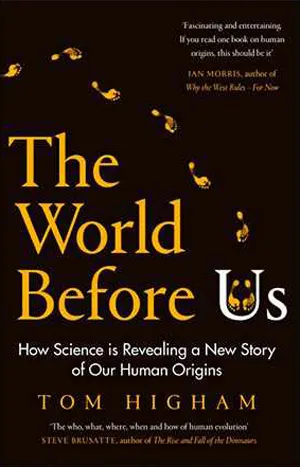
The World Before Us
Tom Higham The World Before Us: The New Science Behind Our Human Origins Yale University Press 320 pages, 6 1/8 x 9 1/4 inches ISBN 9780300259223
Available here →April 19, 2023
20230419-higham-tom-on-book-world-before-us-new-science-behind-our-human-origins-1-1-1
In a nutshell
The rest of this thread
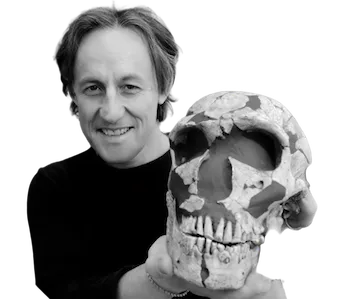
Tom Higham
Originally from New Zealand, Tom Higham is currently Professor of Scientific Archaeology at the University of Vienna’s Department of Evolutionary Anthropology. He came to Vienna in August 2021. For 20 years prior to this he was the Director of the Oxford Radiocarbon Accelerator Unit, at the University of Oxford’s School of Archaeology. This is one of the world’s top radiocarbon dating laboratories. Tom is a specialist in radiocarbon dating using particle accelerators. Tom’s main area of research centers on the Palaeolithic period, particularly the time of the last Neanderthals and the arrival of the first modern humans coming out of Africa. He has worked on more than 100 archaeological sites dating to this period across Eurasia. He is also one of the team working at the important Russian site of Denisova Cave, where a new species of humans was found in 2011 (the Denisovans). Tom has published more than 100 scientific papers. His recent book, The World Before Us: How science is revealing a new story of our human origins, was published in 2021 by Penguin/Random House.
Pull this thread
Human evolution is a braided river, and our being the only surviving Homo is luck rather than cognitive superiority.
Know something the rest of us don't?
Most threads on Rorotoko begin with our invitation. Any thread can begin with a proposal: you write it with the same prompts every thread answers, and we review it.
Propose a thread →