
Tom Higham
The World Before Us
In modern day life, often people look at archaeology and they think, you know that’s interesting, but it’s not relevant to me. But actually, archaeology does have a great deal of relevance, and one can think of several areas.
For example, there’s a huge problem in the world with racism. We have racists everywhere, and the rise of the far right is evident. Racism is a poison that is resulting in serious problems in many branches of society around the world. Some people are very conscious of appearance, skin tone, and so on. What the genetic work is telling us, time and time again, is that all of those differences are very recent, actually, and they are revealing a great deal of complexity in terms of our genetic history.
People living in the British Isles today, for instance, don’t realize that if you go back in time 10,000 years to a man who lived in the west of England in Cheddar Gorge, we see from the genome of that person someone who actually had quite a dark skin tone with blue eyes. And this is a genomic signature that we find again and again right across Europe during the Mesolithic period. It’s a phenotype or physical appearance that we don’t see today due to population replacement. So the ideas of white supremacists, that there existed some pure ‘white’ population from the earliest times is simply wrong, and dangerously wrong of course. Living people are actually the product of a great history of admixture and genetic interbreeding that extends back into deep time. Just as Neanderthals interbred with modern humans, so did virtually every population living today, multiple times. In addition, many aspects of our physical appearance only developed very, very recently.
What is interesting is that many important human adaptations derived from these admixture events and in some cases they help people today to be able to fight the effects of viruses and pathogens. The Denisovans, for example, we think may have adapted quite well to life in the tropics, in places like Island Southeast Asia. Much of the intogressed DNA from Denisovans in living people today in those regions is of immunological significance. We have about 200 Denisovan gene variants that give a greater immunological resistance to diseases of the tropics. Similarly, people who live in Tibet, and the high altitudes, they only survive there in very low oxygen because of a genetic variant that comes from Denisovans. So we can see that these ancient admixture events have a great deal of significance for people living today. The way that they adapt and their future health needs in the age of genomics is quite significant, and the science is increasingly relevant today.
So ancient genomics is relevant for us?
Basically, we kind of take advantage of the fact that other people have lived in these environments and became adapted to the local conditions through natural selection. We just sort of turn up and interbreed with them. And because of the genetic mixing, because of the admixture, we or our offspring are fortunate enough to inherit the gene variant that allows them to resist malaria in the tropics, for example, or some other types of diseases and illnesses that previously our ancestors may have died from.
Recently, a couple of papers came out that showed that a Neanderthal-derived gene variant was implicated in the ability of humans to resist COVID-19 more than other groups. Coincidentally, about six months later, another gene variant was found that actually makes COVID-19 worse; that was derived from a Neanderthal. This gives you an idea of the complexity of looking at the function of these genes. What do they do? How do they protect us, or otherwise? And where do they come from? We only really know this because of the power of ancient genomics, and the fact that Svante Pääbo, who was the main scientific proponent of this science, won the Nobel Prize for Medicine and Physiology a few months ago, shows its great relevance. Chapter 8, Finding Needles in Haystacks, is my favorite because it describes some very exciting work that we did back in 2015-16. We used a new scientific technique called ZooMS on material from this site called Denisova Cave. It’s a technique that allows you to identify tiny bone fragment and work out what kind of animal or in this case human it comes from. You get thousands of bones in archaeological sites, many of which you can’t possibly tell which animal that it comes from. You can’t say, for example, it’s a dog, or it’s a mammoth, or it’s a hyena. It’s just a bone fragment.
We used ZooMS to test thousands of unidentified bones to find hominin or human bone fragments that would otherwise remain unidentifiable. After analyzing more than 1,200 bones, my student, Samantha Brown, identified a tiny little bone about 2.5cm high, which later, using ancient genomics, was shown to have mitochondrial DNA that was Neanderthal-like. So we had found a tiny little fragment of bone belonging to someone who had a Neanderthal mtDNA sequence. Then, when my colleagues in the Max Planck Institute in Leipzig extracted nuclear DNA from it, they found that it was a first-generation hybrid; a girl whose mother was a Neanderthal, but whose father was a Denisovan.
This was a really profound discovery. It’s the first time anybody’s ever found the remains of a genetically so-called ‘hybrid’ person in the world. Working on it was very personal, and it shows how science is often all about persistence, hard work, dedication, collaboration, and having fun and being curious. And I think that’s the message I’d like to get out with the book – that all of this work we do is a lot of fun to work on but also tells us some profound things about our ancestry and who we are.
Samantha nicknamed the bone Denny, which was a bit of fun at the time, but has stuck. She’s known as Denny now. The book has some pictures of the little bone that we found. The paper of the finding was published in Nature, which was a big highlight. I love that whole idea of hybridization. There is going to be a lot of new evidence coming out on this in future, with more and more evidence that genetic admixture has been a major feature of our evolution.And how did your professional path lead you to this book?
My dad is an archaeologist, and he always said, oh, you should really write a book at some point because, you know, as an academic, it’s a really important thing to do. But I was never interested in doing it because I was always writing papers which are short and succinct and that report new results and data, and I didn’t really have time to write a long book. As a scientific researcher and an archaeological scientist, I was always working with other groups, other people, and my own stuff, too, and always seeking to publish papers, short reports, and you know, never a book.
Then in 2015, I was invited to go on a lecture tour of New Zealand. It was fantasitc to go to nine towns and give public lectures about this really important and interesting science. Often, because I was talking about Denisovans, people who came to the lectures would ask questions, and say, is there a book you can recommend that I could read more about this? I couldn’t think of any. So, I thought perhaps I should write one, because I wanted to share some of the work we were doing. And so, after Denny was found, I thought, that’s a great story.
So then I talked to my friend Henry Gee, he’s an author, and I said, Henry, how do you write a book? And he gave me great advice about getting an agent to work with, to then write up a proposal and so on, and eventually it all came together and The World Before Us is the result. It’s been a super experience and wonderful to hear from people who’ve enjoyed reading it too!The story of humanity has often been told as one of humans being at the very top of the tree of life. We’ve always looked at ourselves as exceptional. Whilst we do have a lot of really incredible skills with respect to our culture and language, I think that the research coming out of the wider field of paleoanthropology over the last 20 years suggests that we’re not unique – that Neanderthals and Denisovans and other groups had aspects of cultural adaptation too shows a more complicated world.
These were well adapted human groups that lasted for many hundreds of thousands of years and that but for the vagaries of luck could well have been in our position. We can’t have predicted where in evolutionary terms they may have ended up because of their disappearance from the world.
It’s not that we were cognitively always the most superior. It’s more complicated than that. Over the millennia during which we overlapped in Eurasia, it is possible that we benefited from aspects of that process. We shared DNA with Neanderthals too, of course, 40,000-50,000 years ago, and may have absorbed their populations into ours. I think we should be humble about our achievements because, but for a bit of luck, we may have joined these lost cousins and followed them into extinction.What about climate pressures?
If you look back at the record, particularly through the Paleolithic and the last 100,000 years, you look at the climate, you can see tremendous changes that took place over a very short amount of time that should be pregnant reminders of the dangers we face today with climate switches. For example, 14,700 years ago, all of a sudden, right at the end of the ice age, suddenly the climate changed and temperatures rose between 7 and 10 degrees within two to three years.
We can see climate changing today, but we can also look back and see the evidence for past climate, and imagine what it must have been like having a climate that changed that dramatically. In a short amount of time people had to really think fast and be resilient. We know that populations contracted, and people moved, they had to, so we can anticipate that a similar thing is going to happen today. It is scary when you imagine what could happen if some of these sudden trigger points are reached and catastrophic climate change took place. It sometimes keeps me awake at night.
We know that humans did survive in the past through dramatic climate changes but there were huge costs. We need to modify our behavior and work on improving our technological adaptations. We have the solutions to these problems, but we have to implement them, and fast.
Editor: Judi Pajo
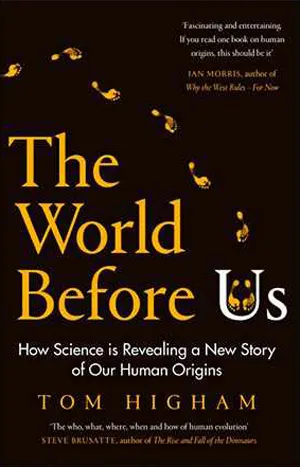
The World Before Us
Tom Higham The World Before Us: The New Science Behind Our Human Origins Yale University Press 320 pages, 6 1/8 x 9 1/4 inches ISBN 9780300259223
Available here →April 19, 2023
20230419-higham-tom-on-book-world-before-us-new-science-behind-our-human-origins-3-1
A close-up
The rest of this thread
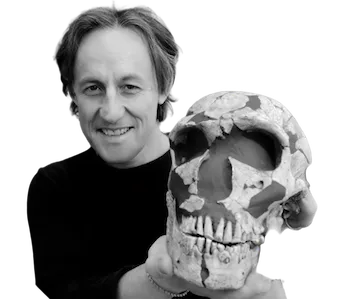
Tom Higham
Originally from New Zealand, Tom Higham is currently Professor of Scientific Archaeology at the University of Vienna’s Department of Evolutionary Anthropology. He came to Vienna in August 2021. For 20 years prior to this he was the Director of the Oxford Radiocarbon Accelerator Unit, at the University of Oxford’s School of Archaeology. This is one of the world’s top radiocarbon dating laboratories. Tom is a specialist in radiocarbon dating using particle accelerators. Tom’s main area of research centers on the Palaeolithic period, particularly the time of the last Neanderthals and the arrival of the first modern humans coming out of Africa. He has worked on more than 100 archaeological sites dating to this period across Eurasia. He is also one of the team working at the important Russian site of Denisova Cave, where a new species of humans was found in 2011 (the Denisovans). Tom has published more than 100 scientific papers. His recent book, The World Before Us: How science is revealing a new story of our human origins, was published in 2021 by Penguin/Random House.
Pull this thread
Human evolution is a braided river, not a branching tree.
Know something the rest of us don't?
Most threads on Rorotoko begin with our invitation. Any thread can begin with a proposal: you write it with the same prompts every thread answers, and we review it.
Propose a thread →