
Robert Hassan
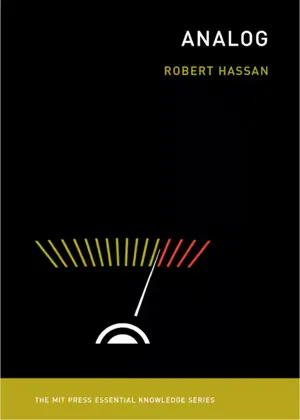
Analog
I have taught and researched media and media theory for over twenty years and have been increasingly struck by how little we understand about the human relationship with technology, particularly as it relates to the present-day domination by digital form. The IT revolution happened so quickly, and with relatively little input by individuals and communities who were simply expected to adopt this new technological category and adapt to its instrumental logic and its monomaniacal orientation towards automation above all else.
Analog had been in gestation for maybe ten years. To research it, I began from the premise that “digital” presents us with an unprecedented philosophical opportunity. We never previously had to ask ourselves: “what is our human relationship with analog technology?” We didn’t ask it because there was nothing to compare analog with, there was no reason to ask the question—it simply didn’t suggest itself—until digital came along. Then digital came so fast, that mostly we forgot to think about what this transition actually meant at the level of ontology; what we had gained and what we had lost.
There is a great deal of research, and much of it boosterism, it must be said, regarding what we purportedly have gained through digitalization. There is efficiency in production (mainly automation), logistics, the Internet, social media, and so on. But little or nothing has been published about what we have lost from an embodied human perspective. And that is quite a lot, as it turns out.
In the writing of the book, I was drawn to the works of Martin Heidegger, Franz Kapp, and especially Arnold Gehlen, of the mid-twentieth century “German School” of philosophical anthropology. These thinkers combine a rigorous philosophical speculation with evidence of anthropology to think more deeply about how humans and technologies evolved to create the cultures, civilizations, and epochs that define us as the dominant species on earth by means of our relationship with technology. This body of work was pretty large, especially in the decades after World War II, but it was also somewhat niche and specialized and had remained that way up until today. For me, the arrival of digital has revivified philosophical anthropology, and compels us to think again, and think more systematically, historically and anthropologically, about what has become the analog-digital question.
Extending the work of Arnold Gehlen, who argues a deep and intrinsic relationship with humans and tools, enabling what he called the “helplessness” of our species to eventually survive and thrive, I argue that the relationship is in fact more than close—it is immanent, evolutionary, and co-constitutive. We evolved as toolmakers in the special way that we did, because we ourselves are a form of living and breathing technology. And we are not just technological—but analog too.
I show this partly through an etymology of the word “analog” itself. Historically, and going back to Democritus and Aristotle, and to Samuel Johnson nearer our own time, it had a much closer association with people as well as tools; but with the rise of digital, the term became associated with technology only, and was quickly framed (and defined) as being the opposite to digital, which we associate almost wholly with computers. As technological creatures of a specific category, therefore, we need to realize that digital is capable of many wonderful things, but it does not reflect who and what we are. We need collectively to control it, make its processes ethical and oriented towards human needs as opposed to purely instrumental and economic ones.
Editor: Judi Pajo
September 21, 2023
2023921-hassan-robert-on-book-analog-2-1
The wide angle
The rest of this thread

Robert Hassan
Robert Hassan teaches at the University of Melbourne. He has held visiting fellowships in Cardiff University, at the IAS at Durham University, and has lectured in the Chinese University of Hong Kong, the University of Baroda, India, and conducted workshops on the politics of time and memory in Srebrenica, Bosnia. His research work is at the intersections of politics, media, political economy, technology, and temporality. He has written twelve books that explore these conjunctions, and have been translated into Chinese, Arabic, and Korean. From 2010 until 2022 he was Editor-in-Chief of Time and Society. His next book, due to be published in2024, is about modern (analog) journalism in a post-modern (digital) world.
Pull this thread
Humans are themselves a technology, and that technology is analog, so digital does not reflect what we are.
Know something the rest of us don't?
Most threads on Rorotoko begin with our invitation. Any thread can begin with a proposal: you write it with the same prompts every thread answers, and we review it.
Propose a thread →