
Robert Hassan
Analog
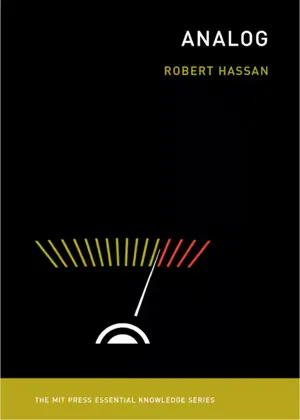
Analog begins with an introductory chapter on retro analog consumer technologies such as vinyl records, single-lens reflex cameras, music cassette tapes, and so on, and how these and many other things are popular today amongst not just older generations, but younger people too. The common rationale for this sustained popularity is that it is an expression of a kind of “nostalgia” for a supposedly simpler time, where cultural objects were tactile, material, and had an authenticity that digital objects don’t possess. Whilst there is something to this, I argue that “nostalgia” itself is an expression of something much deeper, something unarticulated in most of us at a conscious level That’s a feeling of lack or psychic displacement within us; a space created by the virtuality of digital and in the context of being objectively alone with a screen which is the condition that much digital interaction creates.
Being analog, as opposed to “Being Digital”, as Nicholas Negroponte put it in his celebrated eponymous1995 book, tells us why, as social creatures, we are not evolved for the forms of “sociality” that social media imposes upon us today. “Being” in front of a screen for several hours a day is a technologically evolved form of alienation, one we haven’t yet recognized, far less come to terms with. However, if unchecked and left without more regulation and democratic guidance, a digitally induced alienation is set to become our default state of “being” as digital reaches into ever more personal registers of life, of public culture, and democratic discourse.
My book is ambitious in many ways. It is a call to action about something that is so massive, so important, so comprehensive in its effects that, like our general acceptance of the science around climate change while being incapable as a world community to act upon it in decisive ways, we are unprepared psychologically to deal with the consequences, or even to acknowledge the damage already done, by the domination of digital. Moreover, the crisis in our technology relationship is invisible in plain sight, such that it seems kind of absurd to point to it and say: “computers are destroying what it means to be human.” I suppose a humbler desire for Analog is to say that the emergence and domination by digital has given us an opportunity to think more reflectively about our relationship with technology.
In Capital, Marx argued that in industrial society especially, the kinds of technologies we create, reveal something about our relationship with nature and social structures. Industrial machines expressed the need to dominate and exploit Nature, and for one class to dominate and exploit another. The orientation of industry and the machines it created, an orientation held back only by the level of technological sophistication at any given time, was to replace the human completely by machine process. And so, the underlying logic of capitalism, a system driven by competition whose rationality is to replace the human component in production through automation, is a logic that would lead inexorably to computerization.
It is no coincidence in nomenclature that the first working analog calculating machine devised by Charles Babbage in the 1820s was designed principally to replace “computers”–the name given to those who crunched the numbers for banks, insurance companies, etc., and who, like all humans were prone to sometimes costly error. And Arnold Gehlen, the philosopher of technology and anthropology wrote in his Man in the Age of Technology that “Technology is as old as man himself, for when we deal with fossil remains it is only when we come upon traces of the use of fabricated tools that we feel sure we are dealing with men.” He saw a “deep seated bond” between humans and technology. So do I.I agree with Marx, too, that technology is encoded with the social and economic conditions of the “mental conceptions” as Marx called them, that bring any particular technology into being. Consequently, capitalism leads to the commercial Internet. This outcome wasn’t preordained, but something like it certainly was. In Analog, I wanted to push a revivified philosophical anthropology a little further and a little deeper in the light of digitality and argue that we are technology, and that form of evolved technology is and always has been analog. This is how we developed as Homo sapiens. And the tools that we developed, especially from the beginnings of the scientific revolution and the modern era, reflected much more our human needs and wants in all their diversities, and all across the pre-modern world.
I don’t argue that we need to get to some pre-modern age. Of course not. Digital technology and all that it has created cannot be uninvented. But its progress and its direction and application can be oriented toward human ends through democratic accountability. Failure to do so, leads inexorably to the opposite of democracy, something that Norbert Wiener, the inventor of cybernetics, foresaw. In The Human Use of Human Beings he wrote:Let us remember that the automatic machine, whatever we think of any feelings it may have or may not have, is the precise economic equivalent of slave labor. Any labor which competes with slave labor must accept the economic conditions of slave labor.
To accept that we are technology, and that we are analog as well, will enable us to see what digital actually is. And it’s not who we are. Once we see it as antithetical to our needs if unconstrained, then once constrained we will have a tool that could create unimaginably positive things for our species, for Nature, and for the planet.
Editor: Judi Pajo
September 21, 2023
2023921-hassan-robert-on-book-analog-3-1
A close-up
The rest of this thread

Robert Hassan
Robert Hassan teaches at the University of Melbourne. He has held visiting fellowships in Cardiff University, at the IAS at Durham University, and has lectured in the Chinese University of Hong Kong, the University of Baroda, India, and conducted workshops on the politics of time and memory in Srebrenica, Bosnia. His research work is at the intersections of politics, media, political economy, technology, and temporality. He has written twelve books that explore these conjunctions, and have been translated into Chinese, Arabic, and Korean. From 2010 until 2022 he was Editor-in-Chief of Time and Society. His next book, due to be published in2024, is about modern (analog) journalism in a post-modern (digital) world.
Pull this thread
Humans are themselves a technology, and that technology is analog, so digital does not reflect what we are.
Know something the rest of us don't?
Most threads on Rorotoko begin with our invitation. Any thread can begin with a proposal: you write it with the same prompts every thread answers, and we review it.
Propose a thread →