
Niko Kolodny
The Pecking Order
Much in our interior mental lives and in our exterior social structures presupposes that we, human beings, are conscious of social hierarchy, of differences in rank and status. This book, first, offers a philosophical analysis of what social hierarchy is. Second, it suggests that we cannot make sense of many familiar ideas about society and politics, both in high theory and in ordinary discourse, without presupposing that there is a distinctive objection to being set beneath another in a social hierarchy—without presupposing that there is a value of “noninferiority.” It is not enough to appeal to the fair distribution of goods and the protection of natural rights, as many political philosophers do.
What are these familiar ideas, which can only be fully explained by an objection to social hierarchy? They include:
- that there is a problem with the state’s “coercion” of those subject to it that requires the state to clear a special bar of “justification” or “legitimacy”;
- that there is a prohibition on “illiberal” interference, such as fines, in choices of certain kinds, such as religion;
- that public officials should not abuse their offices corruptly;
- that people are entitled to democratic structures of decision-making, which give each person, at some appropriate level, if not at all levels, an equal say;
- that there is an objection to discrimination on the basis, say, of gender or race;
- and that people have claims to enjoy the same liberty, opportunity, and treatment that others in one’s society enjoy.
As to how I would like a reader to read the book, it will help, first, to highlight its recurring, three-part structure. It begins with a familiar idea, like one of those listed above. It then observes, negatively, that the idea cannot be explained by appealing to the fair distribution of goods or the protection of natural rights. It then conjectures, positively, that the idea can be explained by appealing to the value of noninferiority, to an objection to being set beneath another in a social hierarchy. It then repeats with another familiar idea, and so on.
Now, it is a very long book. I don’t advise a forward march through the whole thing at first—unless you have angelic patience or a thing for endurance events! The introduction suggests a first pass through the book, which gives the reader one instance of the three-part structure, along with a characterization of the value of noninferiority. With that in the rearview mirror, the reader can then make pit-stops at the topics that most interest them, such as, say, discrimination or democracy.
However, I would hope that if the reader has doubts about the book’s main positive conjecture—namely, that noninferiority is a freestanding value, that there is an objection to social hierarchy that cannot be explained in other terms—that the reader then take the time to read through other instances of the three-part structure before rendering a final verdict. The case for the positive conjecture is ultimately cumulative.
Editor: Judi Pajo
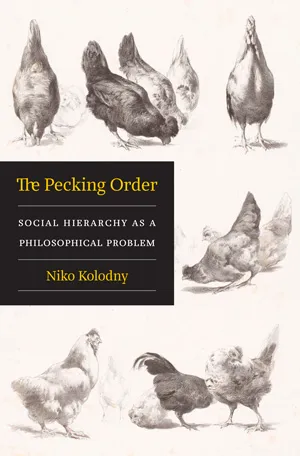
The Pecking Order
Niko Kolodny The Pecking Order: Social Hierarchy as a Philosophical Problem Harvard University Press 496 pages, 6 1/8 x 9 1/4 inches ISBN 978 0674248151
Available here →February 1, 2024
20240201-kolodny-niko-on-book-pecking-order-social-hierarchy-philosophical-problem-1-1-1
In a nutshell
The rest of this thread

Niko Kolodny
Niko Kolodny received his PhD in Philosophy from the University of California, Berkeley in 2003, where he is currently Professor of Philosophy. Specializing in moral and political philosophy, he has written papers on a wide range of topics, including rationality, promising, love, democracy, justifying the state, modus ponens, future generations, and Rousseau. His teaching is largely on the ethics of emerging technologies. For the 2023–24 academic year, he is a Fellow at the Wissenschaftskolleg zu Berlin (Institute of Advanced Study at Berlin), working on a project on privacy in a digital age.
Pull this thread
Being set beneath another person is a wrong in its own right.
Know something the rest of us don't?
Most threads on Rorotoko begin with our invitation. Any thread can begin with a proposal: you write it with the same prompts every thread answers, and we review it.
Propose a thread →