
Niko Kolodny
The Pecking Order
As to what pages of the book I would hope a browser encountered first, I will say, unsurprisingly, the introduction and conclusion. The introduction spells out in a bit more depth the “nutshell” pitch above. It also assures the reader that there is an initial path through the book that requires reading only about a quarter of its total length.
The conclusion presents a different way of thinking about the lesson of the book. That lesson is that what drives much of our political thought and feeling is less, as it may first appear, a jealousy for individual freedom and more an apprehension of interpersonal inequality. The book also might be seen as a kind of slow-motion, anti-libertarian judo. Press hard enough on some complaints of unfreedom and you end up in a posture not so much of defense of personal liberty as opposition to social hierarchy.
Or, perhaps a better way of putting the point is that the opposition to social hierarchy can be understood as a claim to liberty of a different kind. On one understanding of liberty, you are free insofar as you are resourced to chart a life according to your choices. On another understanding, you are free insofar as you are insulated from invasion by others. Noninferiority represents a further conception of liberty: freedom understood as having no other individual as master, as being subordinate to no one.
It is perhaps also worth saying which pages of the book I hope the reader would not encounter first. I wouldn’t want the reader to be plunged headlong into the thicket of detail. By that I mean the stretches in which I argue negatively that we cannot make sense of some familiar idea—such as, say, that the state stands in need of justification—by appealing to a fair distribution of goods or natural rights. Much of the book’s argument is in the weeds, but I don’t expect the reader to descend into them without first getting a reasonably clear view of what’s on the other side of the meadow.
The book does not offer policy proposals, or at least specific ones, designed to realize noninferiority. Its aim is rather to understand why values that I take the reader to share are values, why they matter in the first place. For instance, I don’t have any solution to the problems threatening democracy, as concerned as I am, as one citizen among others, about that. But the book does offer one understanding of why the loss of democracy would be a loss.
Perhaps my aspirations for the book are best captured by its closing paragraph:If we take the longest historical view, the question that we have been exploring comes to seem not a recent, adventitious preoccupation. Instead, it comes to seems one of the first questions of politics: If complex, large-scale society—if, in one sense of the word, civilization—requires a differentiation of roles and a concentration of power and authority, can it be reconciled with the equality of standing that was guarded so jealously before? It is a question that one imagines those on the margins of the first kingdoms and empires must have asked themselves, in that uneasy season between when they first grasped the strange, new terms of life on offer and when they fled beyond the hinterlands or were compelled, by force of arms or lack of alternatives, to accept those terms. The aim of the book has been to suggest that we philosophers bring this question into more explicit reflection.
Editor: Judi Pajo
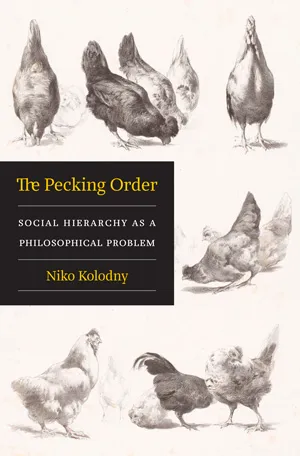
The Pecking Order
Niko Kolodny The Pecking Order: Social Hierarchy as a Philosophical Problem Harvard University Press 496 pages, 6 1/8 x 9 1/4 inches ISBN 978 0674248151
Available here →February 1, 2024
20240201-kolodny-niko-on-book-pecking-order-social-hierarchy-philosophical-problem-3-1
A close-up
The rest of this thread

Niko Kolodny
Niko Kolodny received his PhD in Philosophy from the University of California, Berkeley in 2003, where he is currently Professor of Philosophy. Specializing in moral and political philosophy, he has written papers on a wide range of topics, including rationality, promising, love, democracy, justifying the state, modus ponens, future generations, and Rousseau. His teaching is largely on the ethics of emerging technologies. For the 2023–24 academic year, he is a Fellow at the Wissenschaftskolleg zu Berlin (Institute of Advanced Study at Berlin), working on a project on privacy in a digital age.
Pull this thread
There is a freestanding objection to being set beneath another, irreducible to fair distribution or natural rights.
Know something the rest of us don't?
Most threads on Rorotoko begin with our invitation. Any thread can begin with a proposal: you write it with the same prompts every thread answers, and we review it.
Propose a thread →