
Gary Saul Morson
Wonder Confronts Certainty
Russians are famous for taking ideas to the extreme and then acting on them. That is why they created totalitarianism. Russian thinkers before Communism also tended to take ideas to the extreme, and so they show us the implications of the theories we entertain. That is why, even before the Revolution, Russia was the first society where terrorism became an honored profession. (It also created the genre of the prison camp novel and the dystopia.)
Soviets were so convinced their ideology was right that they were willing to destroy tens of millions of lives.
In reaction to this thinking, the great writers insisted that we can never be so certain. We live in a world where our theories about society and morality prove too simple in light of experience. The realist novel, as the Russians practiced it, became a genre expressing the irreducible complexity of things. People never exactly resemble each other or conform neatly to theories.
The situations in which we make moral descriptions are far more complex than the paradigm cases that the law or social norms presuppose. The proper relation to the world is therefore not absolute certainty but endless wonder. We should always be skeptical of our own most cherished beliefs, especially those that warrant our being cruel to others. Soviet communism shows us what happens if we don’t. While Soviet experience showed us evil – subsequently repeated in Nazi Germany, Mao’s China, Polk Pot’s Cambodia and elsewhere – on a previously unimagined scale, Russian literature explored the nature of evil and why people are drawn to it.
Often enough, those who commit these crimes think they are saving the world, but the writers show, nothing causes more misery than attempts to abolish evil altogether. It isn’t true that the line between good and evil runs between nations, political parties, or any other social groups, as self-righteous political fanatics presume. No, as novelist Aleksander Solzhenitysn famously concluded from his own experience in the Soviet forced labor camp system, the line between good and evil “runs through every human heart,” including our own.
I came to this project from a lifetime of reading the great works that pose the ultimate questions. Isn’t life too short to postpone asking them? I wanted to help others sense their importance for the way they live.
Editor: Judi Pajo
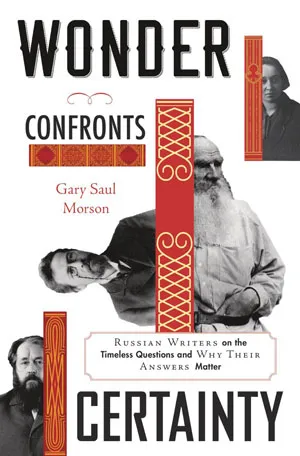
Wonder Confronts Certainty
Gary Saul Morson Wonder Confronts Certainty: Russian Writers on the Timeless Questions and Why Their Answers Matter Harvard University Press 512 pages, 6-1/8 x 9-1/4 inches ISBN 978 0674971806
Available here →February 29, 2024
20240229-gary-morson-wonder-confronts-certainty-2-1
The wide angle
The rest of this thread
Gary Saul Morson
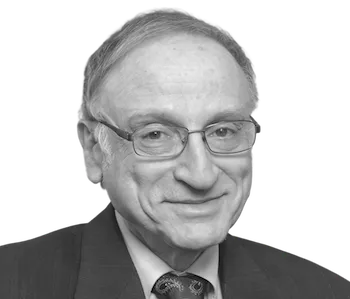
Gary Saul Morson is Lawrence B. Dumas Professor of the Arts and Humanities and Professor of Russian Literature at Northwestern University, where his course on Tolstoy and Dostoevsky has enrolled over 500 students. He is author or editor of 21 books addressing the great Russian writers, the nature of time, the role of quotations in culture, and the aphorism as a literary/philosophical genre. A member of the American Academy of Arts and Sciences, he has won “best book of the year” awards from the American Comparative Literature Association and the Association for Teachers of Slavic and East European Languages.
Pull this thread
Certainty, not malice, produced the twentieth century's mass murder.
Know something the rest of us don't?
Most threads on Rorotoko begin with our invitation. Any thread can begin with a proposal: you write it with the same prompts every thread answers, and we review it.
Propose a thread →