
Gary Saul Morson
Wonder Confronts Certainty
The book’s introduction and conclusion offer a real taste of how it proceeds. In the introduction, I first describe an ancient literary form that served as my model. Called “the dialogues of the dead,” it imagined conversations in the underworld of thinkers or heroes who lived centuries apart, but who can now meet to discuss the ultimate questions of life.
This form has been practiced up to the present: What would Socrates say to Shakespeare, or Caesar to Napoleon? My book imagines such conversations about the ultimate questions of life conducted by Russian writes and political figures as if they could address each other directly. I view the Russian experience – and life in general – as a great conversation, a symposium extending over time.
The introduction also shows readers how intense Russian literary creativity in the nineteenth century was – there has never been a period where more geniuses wrote in such a short period – in order to have my readers share a sense of how exciting that time was.
The conclusion returns the reader to the dialogic sense of life and examines the need for self-questioning, wise laughter, and the willingness to listen to those unlike ourselves.
My readers could also just turn to chapter 11 on the meaning of life – “What Doesn’t It All Mean? The Trouble with Happiness” – to get a taste of the sort of questions the book addresses.
Most of my students have not been taught great literature in a way that makes them want to read more. Sometimes it is presented technically – let’s find symbols! – or judged by the standards of today (Shakespeare didn’t know about recycling), as if we are wiser than the great writers of the past. I want this book to help people appreciate what great literature can show them, why there is no better place to learn empathy than with those who think or feel differently, why it offers ideas about love, death, moral decisions, and other matters we are all concerned with, deeper and wiser than are available elsewhere.
Russian literature does all this explicitly. Russian experience also shows people the implications of ideas or attitudes – especially those of which we are all too certain! – that seem good but in practice cause untold misery. Today, when technology gives people power over each other they never had before, the need to have a wise understanding of people and moral concerns is even more important than before.
Editor: Judi Pajo
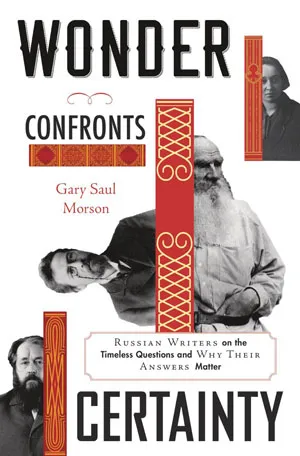
Wonder Confronts Certainty
Gary Saul Morson Wonder Confronts Certainty: Russian Writers on the Timeless Questions and Why Their Answers Matter Harvard University Press 512 pages, 6-1/8 x 9-1/4 inches ISBN 978 0674971806
Available here →February 29, 2024
20240229-gary-morson-wonder-confronts-certainty-3-1
A close-up
The rest of this thread

Gary Saul Morson
Gary Saul Morson is Lawrence B. Dumas Professor of the Arts and Humanities and Professor of Russian Literature at Northwestern University, where his course on Tolstoy and Dostoevsky has enrolled over 500 students. He is author or editor of 21 books addressing the great Russian writers, the nature of time, the role of quotations in culture, and the aphorism as a literary/philosophical genre. A member of the American Academy of Arts and Sciences, he has won “best book of the year” awards from the American Comparative Literature Association and the Association for Teachers of Slavic and East European Languages.
Pull this thread
Certainty, not malice, produced the twentieth century's mass murder.
Know something the rest of us don't?
Most threads on Rorotoko begin with our invitation. Any thread can begin with a proposal: you write it with the same prompts every thread answers, and we review it.
Propose a thread →