
Marc Stein
Bicentennial: A Revolutionary History of the 1970s
My previous books and many of my other publications have focused primarily on LGBTQ history, and for a long time I imagined this book as a project that would queer the bicentennial. My Ph.D. dissertation and first book, which addressed gay and lesbian history in Philadelphia, was originally supposed to conclude with 1976, but I only made it to 1972, the year of Philadelphia’s first gay pride march. I long wanted to return to the stories I had researched but not addressed in that early project but kept getting distracted by other research interests. I had in mind an irreverent triptych, addressing the bicentennial queer courtship of Nixon and Rizzo, bicentennial queer commerce as represented in a gay porn magazine feature called “Philadelphia Freedom,” and bicentennial queer activism as captured in the oral histories I had conducted for my dissertation and first book.
When I finally made the bicentennial my research priority in anticipation of the commemoration of US 250 in 2026, I slowly came to the realization that the book would be queer-inclusive but not queer-focused. Mostly that’s because I realized that there were so many untold stories about African Americans, Asian Americans and Pacific Islanders, Latinos, Native Americans, people with disabilities, and women, but I also realized that I could make another intervention by treating LGBTQ history as important but not primary in my book. We now have hundreds of great books on LGBTQ history, but non-LGBTQ historians rarely address LGBTQ history in their works. I hope Bicentennial provides a model for how to do so and shows that LGBTQ history is American history. As for the queer material that ended up on the cutting room floor, I plan to present this in an upcoming OutHistory website exhibit.
Curator: Bora Pajo
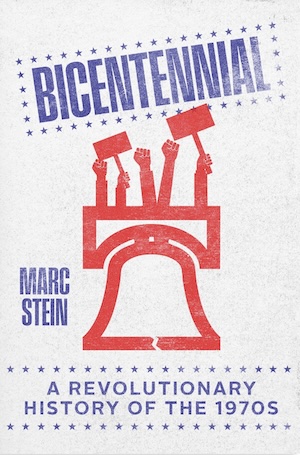
Bicentennial: A Revolutionary History of the 1970s
Stein, Marc. Bicentennial: A Revolutionary History of the 1970s. Chicago: University of Chicago Press, 416 pages, 6 x 9 inches, ISBN: 978-0226847412
Get the book →May 25, 2026
20250525-stein-marc-bicentennial-a-revolutionary-history
The wide angle
The rest of this thread

Marc Stein
Marc Stein is the Jamie and Phyllis Pasker Professor of U.S. History and Constitutional Law at San Francisco State University. He is the 2026-27 president of the Organization of American Historians, the executive director of OutHistory, and the author of six books, including City of Sisterly and Brotherly Loves: Lesbian and Gay Philadelphia, 1945-1972 (2000); Sexual Injustice: Supreme Court Decisions from Griswold to Roe (2010); Rethinking the Gay and Lesbian Movement (2012, 2023); The Stonewall Riots: A Documentary History (2019); Queer Public History: Essays on Scholarly Activism (2022); and Bicentennial: A Revolutionary History of the 1970s.
Know something the rest of us don't?
Most threads on Rorotoko begin with our invitation. Some begin with a proposal. Both use the same prompts and the same editing, with your own pages in the archive. Proposed threads carry a small Sponsored label and a fee.
Propose a thread →