
Robin Feldman
AI Versus IP
The United States Constitution laid the groundwork for the intellectual property regime—giving Congress the power: “To promote the Progress of Science and useful Arts, by securing for limited Times to Authors and Inventors the exclusive Right to their respective Writings and Discoveries.”
Across hundreds of years, the core concepts of what we protect and why we protect it have remained relatively stable. Through tectonic technological shifts—the industrial revolution, the digital revolution, and the proliferation of the internet, smartphones, and social media—these core concepts have persisted. But artificial intelligence poses a different kind of challenge.Artificial intelligence is commonly defined as ‘the use of computing systems for automating tasks that would normally require human intelligence.’ But AI involves so much more than that simple phrase suggests: AI is a combination of fields that enable a system to function in a manner remarkably reminiscent of the human brain. But AI is not a “thing” or an “it;” AI is a way of going about doing something.Scholars have discussed numerous issues in the realm of AI and intellectual property (IP), including: whether AI itself should be deemed a creator; whether the output of an AI can be protected under intellectual property regimes; whether AI infringes on the IP rights of others; and how AI should be regulated. One issue, however, remains largely unexamined: As AI continues to embed itself throughout society, it will progressively shake loose the foundations of what we choose to protect with IP, forcing us to reconsider how IP derives its value.
My bookAI Versus IP: Rewriting Creativityexamines the rapidly developing intersections of AI and the IP regimes. Through examining each pillar of IP in turn—copyright, patent, trademark, and trade secret—I delve into the specific challenges and possibilities AI offers for each case. Using analogies to the Bridgerton fantasy series and the Good Housekeeping “Seal of Approval,” I describe how AI is set to shrink not only the pool of materials eligible for intellectual property protection but also the value of IP regimes as we know them. In other words, AI may decrease the value of the protection umbrella itself.
These rapid changes do not doom the system wholesale. The book describes how the legal system can trim what is classed as protectable, casting the net only around the remarkable and thereby preserving value. Furthermore, the legal system could restore confidence in both AI and IP through the establishment of a public–private certification body. I conclude that, together, these approaches would mitigate the problems looming ahead for the four intellectual property regimes.
Curator: Bora Pajo
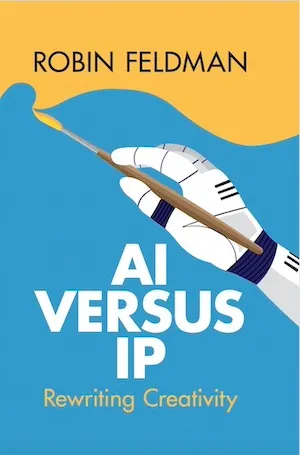
AI Versus IP
Robin Feldman AI Versus IP: Rewriting Creativity Cambridge University Press 228 pages, 6 x 9 inches, ISBN 978-1009646864
Available here →September 5, 2025
20250905-feldman-robin-on-ai-versus-ip-1-1
In a nutshell
The rest of this thread

Robin Feldman
Professor Feldman is an award-winning scholar and science writer whose work has been called "absolutely remarkable" and "a must read." Her areas of emphasis include Law and Al, Law and Medicine, and Competition.Sheis the Arthur J. Goldberg Distinguished Professor of Law at University of California Law, San Francisco, and Director of theAI Law & Innovation Institute.
Pull this thread
AI's real threat to intellectual property is that it shrinks what is worth protecting.
Know something the rest of us don't?
Most threads on Rorotoko begin with our invitation. Any thread can begin with a proposal: you write it with the same prompts every thread answers, and we review it.
Propose a thread →